 …
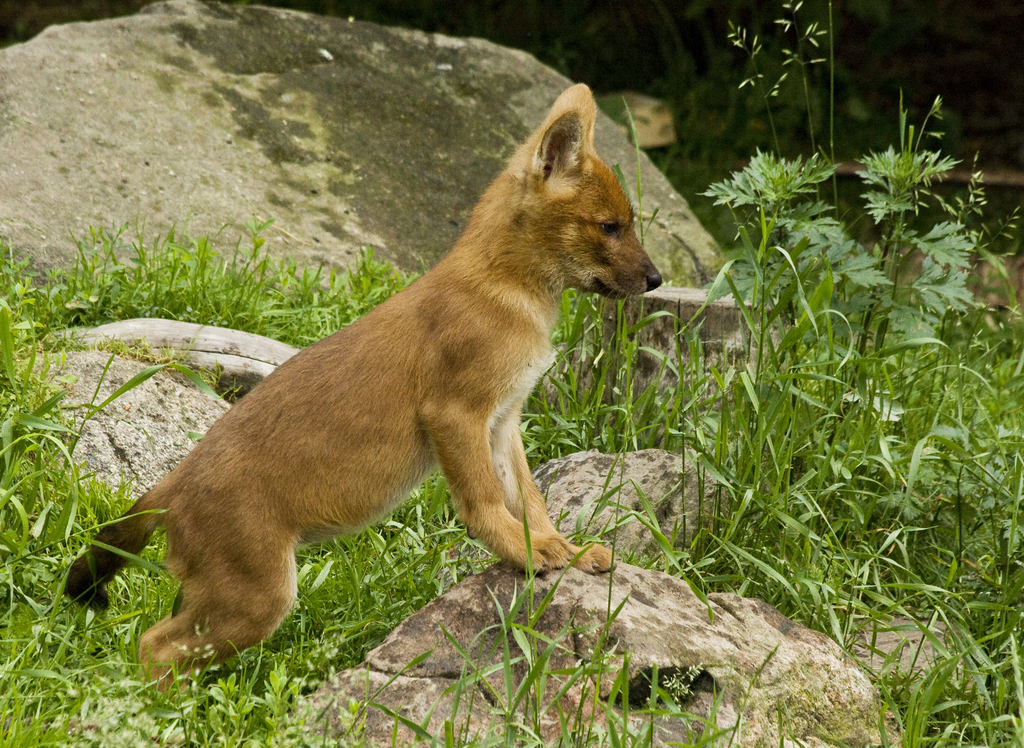
Dhole
Cuon alpinus
Mammalstrong against birds, fungi
Epic
Pack
While active with another mammal in play, it hits 7 harder (14 with two others).
42

43
Dhole
Cuon alpinus
Mammalstrong against birds, fungi
Epic
While active with another mammal in play, it hits 7 harder (14 with two others).
Cuon alpinus
Photo: Johan Spaedtke (original photo) · public domain (licence text) · cropped
Strong against: it deals 20% more damage to them. Weak against: these types deal 20% more damage to it.
The dhole ( dohl; Cuon alpinus) is a canid native to South, East and Southeast Asia. The sole member of the genus Cuon, it is anatomically distinguished from members of the genus Canis in several aspects: its skull is convex rather than concave in profile, it lacks a third lower molar, and the upper molars possess only a single cusp as opposed to between two and four. During the Pleistocene, the dhole ranged throughout Asia, with its range also extending into Europe (with a single putative, controversial record also reported from North America) but became restricted to its historical range 12,000–18,000 years ago. It is now extinct in Central Asia, parts of Southeast Asia, and possibly the Korean Peninsula and Russia.
The dhole is a highly social animal, living in large clans without rigid dominance hierarchies and containing multiple breeding females. Such clans usually consist of about 12 individuals, but groups of over 40 are known. It is a diurnal pack hunter which preferentially targets large and medium-sized ungulates. In tropical forests, the dhole competes with the tiger (Panthera tigris) and the leopard (Panthera pardus), targeting somewhat different prey species, but still with substantial dietary overlap.
Abridged excerpt from the Wikipedia article Dhole, by its authors, under the CC BY-SA 4.0 licence.
Endangered on the IUCN Red List: that’s what makes this card Epic.
Every Epic card has 145 points, shared between HP, ATK and DEF:
How they’re shared out:

 DEF 43