 …
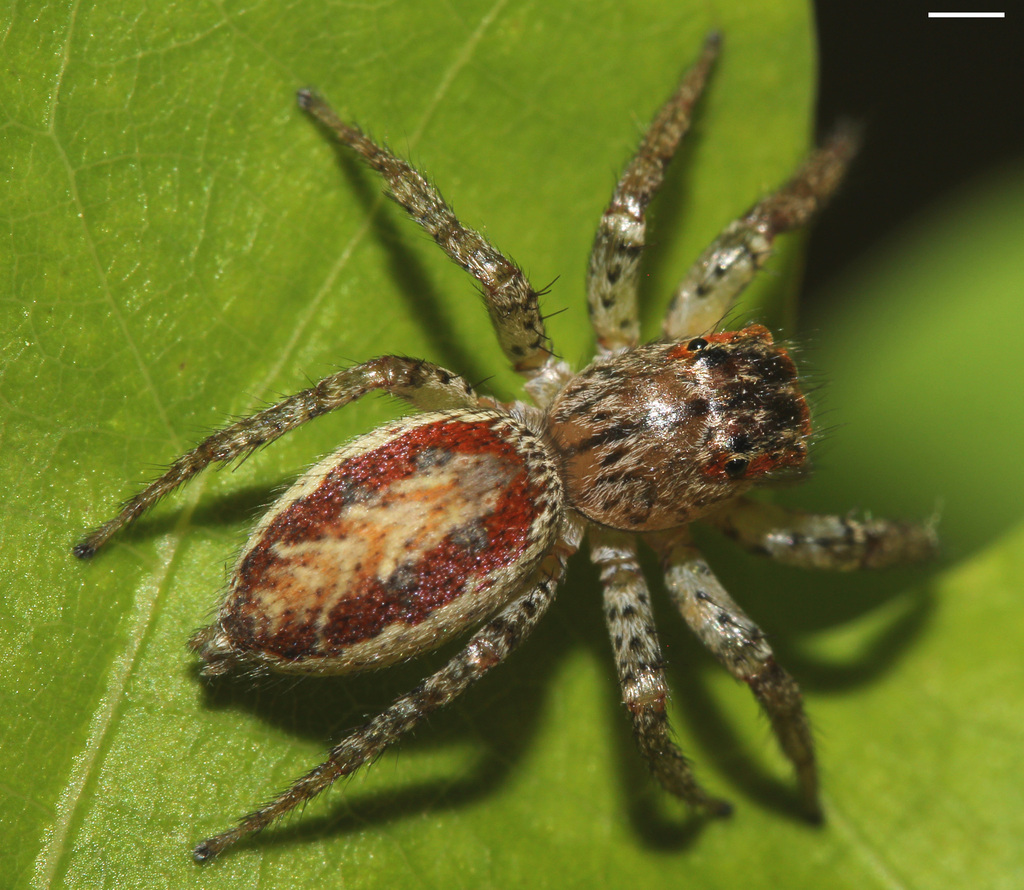
Dimorphic Jumping Spider
Maevia inclemens
Arachnidstrong against insects, birds
Common
Venom
While active with another arachnid in play, its target loses 4 HP at the start of each of its turns, as long as it stays active (7 with two others).
42

28
Dimorphic Jumping Spider
Maevia inclemens
Arachnidstrong against insects, birds
Common
While active with another arachnid in play, its target loses 4 HP at the start of each of its turns, as long as it stays active (7 with two others).
Maevia inclemens
Photo: © platycryptus (original photo) · CC BY 4.0 (licence text) · cropped
Strong against: it deals 20% more damage to them. Weak against: these types deal 20% more damage to it.
Maevia inclemens or the dimorphic jumping spider is a relatively common and colorful jumping spider of North America. In the males there are two forms, a very rare phenomenon in zoology. These use different courting displays, and differ in appearance: the "tufted" morph has a black body and pedipalps ("palps"), three black tufts across its "head", and pale legs; and the "gray" morph has black and white stripes all over its body and legs, orange palps, and no tufts. However, each form accounts for 50% of the adult males, and they are equally successful in mating.
Like all jumping spiders, M. inclemens has excellent vision. The main eyes, in the front-and-center position, are large, and are more acute than those of a cat and about 10 times as acute as a dragonfly's. The remaining three pairs of eyes are along the sides of the head, and work as motion detectors. The eyes are used for hunting, for avoiding threats and for finding mates.
Maevia inclemens is one of the eight species in genus Maevia. The species was first called Attus inclemens, and other names have been used. The two male forms look and behave so differently that they were originally considered two distinct species. In 1955 Robert Barnes chose M. inclemens, and this has become the standard name.
The species is found in south-eastern Canada, and in the eastern United States. M. inclemens is frequently seen on man-made structures such as outbuildings or fences.
Excerpt from the Wikipedia article Maevia inclemens, by its authors, under the CC BY-SA 4.0 licence.
No global status on the IUCN Red List: that’s what makes this card Common.
Every Common card has 100 points, shared between HP, ATK and DEF:
How they’re shared out:

 DEF 28