
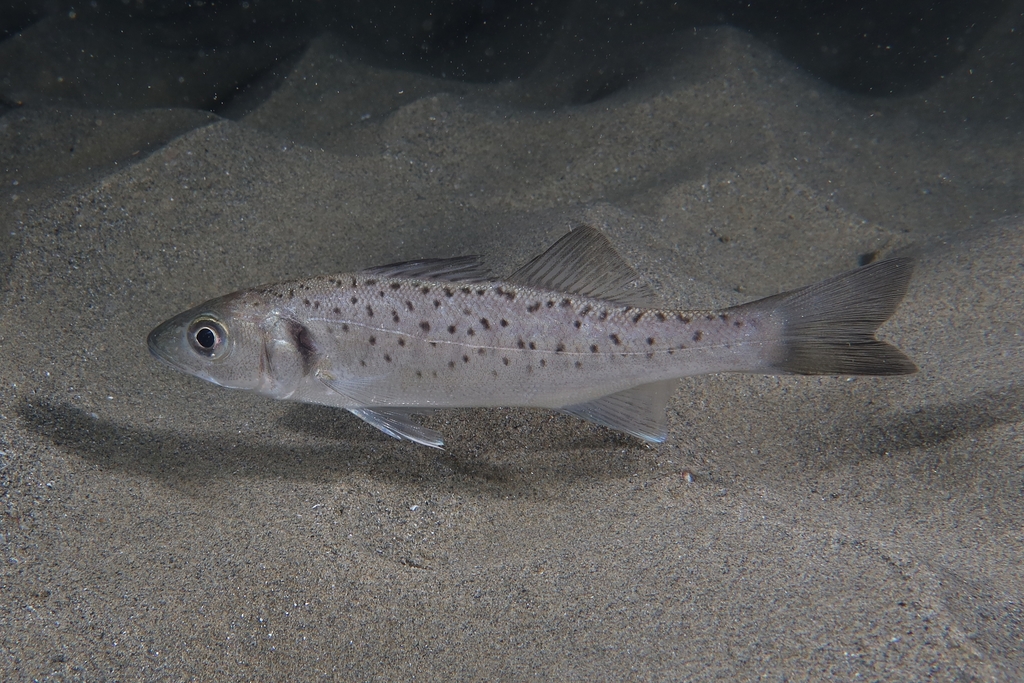
European Seabass
Dicentrarchus labrax
Fishstrong against mammals, arachnids
Uncommon
While active with another fish in play, a fish on your bench absorbs up to 9 of the damage this card takes, without being knocked out (18 with two others).

European Seabass
Dicentrarchus labrax
Fishstrong against mammals, arachnids
Uncommon
While active with another fish in play, a fish on your bench absorbs up to 9 of the damage this card takes, without being knocked out (18 with two others).
Dicentrarchus labrax
Photo: © Julien Renoult (original photo) · CC BY 4.0 (licence text) · cropped
Strong against: it deals 20% more damage to them. Weak against: these types deal 20% more damage to it.
European seabass (Dicentrarchus labrax), also known as branzino, European bass, sea bass, common bass, white bass, capemouth, white salmon, white mullet, sea dace, levrek or loup de mer, or lavraki (λαβράκι) is a primarily ocean-going fish native to the waters off Europe's western and southern and Africa's northern coasts, though it can also be found in shallow coastal waters and river mouths during the summer months and late autumn. It is one of only six species in its family, Moronidae, collectively called the temperate basses.
It is fished and raised commercially and is considered the most important fish currently cultured in the Mediterranean. In Ireland and the United Kingdom, the popular restaurant fish sold and consumed as sea bass is exclusively the European bass. In North America, it is widely known by one of its Italian names, branzino.
European seabass is a slow-growing species that takes several years to reach adulthood. An adult European seabass usually weighs around 2.5 kg (5 lb 8 oz). European seabass can reach measurements of up to 1 m (3 ft 3 in) in length and 12 kg (26 lb) in weight, though the most common size is only about half of that at 0.5 m (1 ft 8 in). Individuals are silvery grey and sometimes a dark-bluish color on the back.
Abridged excerpt from the Wikipedia article European seabass, by its authors, under the CC BY-SA 4.0 licence.
Near Threatened on the IUCN Red List: that’s what makes this card Uncommon.
Every Uncommon card has 115 points, shared between HP, ATK and DEF:
How they’re shared out:

