 …
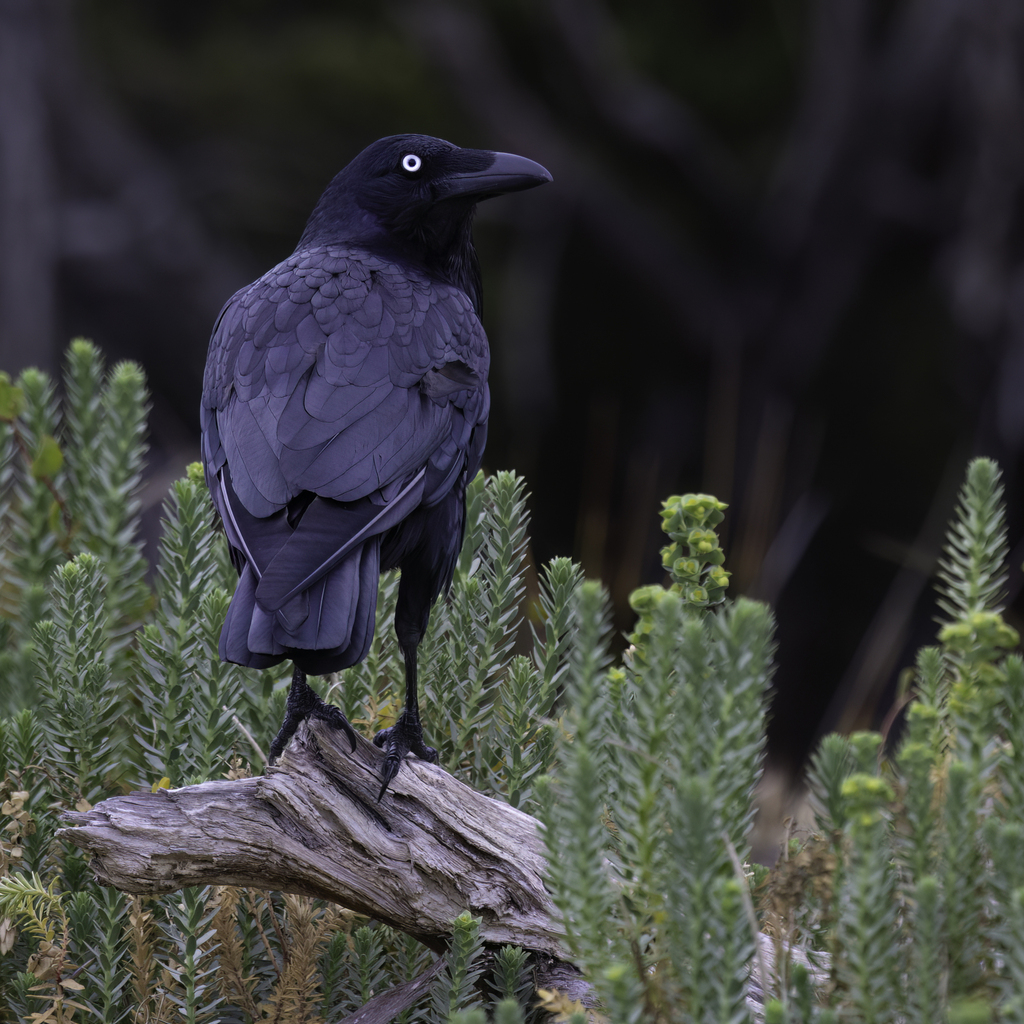
Australian Raven
Corvus coronoides
Birdstrong against fish, reptiles
Common
Swoop
While active with another bird in play, it hits 6 harder on its first attack after entering play (12 with two others).
28

33
Australian Raven
Corvus coronoides
Birdstrong against fish, reptiles
Common
While active with another bird in play, it hits 6 harder on its first attack after entering play (12 with two others).
Corvus coronoides
Photo: julie burgher (original photo) · CC0 (licence text) · cropped
Strong against: it deals 20% more damage to them. Weak against: these types deal 20% more damage to it.
The Australian raven (Corvus coronoides) is a passerine corvid bird native to Australia. Measuring 46–53 centimetres (18–21 in) in length, it has an all-black plumage, beak and mouth, as well as strong, greyish-black legs and feet. The upperparts of its body are glossy, with a purple-blue, greenish sheen; its black feathers have grey bases. The Australian raven is distinguished from the Australian crow, and other related corvids, by its long chest feathers, or throat hackles, which are prominent in mature birds. Older individuals and subadults have white irises, while the younger birds' eyes display blue inner rims; hatchlings and young birds have brown, dark irises until about fifteen months of age, at which point their irises become hazel-coloured, with an inner blue rim around each pupil, this lasting until they are roughly 2.5 to 3 years of age. Nicholas Aylward Vigors and Thomas Horsfield described the Australian raven in 1827, its species name coronoides highlighting its similarity with the carrion crow (C. corone). Two subspecies are recognised, which differ slightly in their vocalisations, and are quite divergent, genetically.
Abridged excerpt from the Wikipedia article Australian raven, by its authors, under the CC BY-SA 4.0 licence.
Least Concern on the IUCN Red List: that’s what makes this card Common.
Every Common card has 100 points, shared between HP, ATK and DEF:
How they’re shared out:

 DEF 33