 …
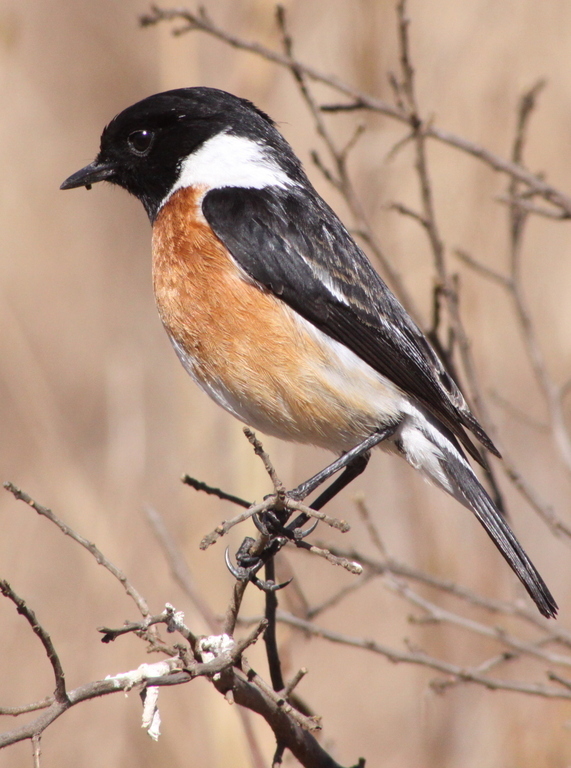
African Stonechat
Saxicola torquatus
Birdstrong against fish, reptiles
Common
Swoop
While active with another bird in play, it hits 6 harder on its first attack after entering play (12 with two others).
29

38
African Stonechat
Saxicola torquatus
Birdstrong against fish, reptiles
Common
While active with another bird in play, it hits 6 harder on its first attack after entering play (12 with two others).
Saxicola torquatus
Photo: © Derek Keats (original photo) · CC BY 4.0 (licence text) · cropped
Strong against: it deals 20% more damage to them. Weak against: these types deal 20% more damage to it.
The African stonechat or common stonechat (Saxicola torquatus) is a species of the Old World flycatcher family (Muscicapidae), inhabiting sub-Saharan Africa and adjacent regions. Like the other chats, it was long assigned to the thrush family (Turdidae), to which the chats are convergent. Its scientific name refer to its appearance and habitat and means "collared rock-dweller": Saxicola from Latin saxum ("rock") + incola ("one who dwells in a place"), torquatus, Latin for "collared".
In the past S. torquatus usually referred to the entire "common stonechat" superspecies and some sources still keep it that way, but all available evidence strongly supports full species status for the European (S. rubicola) and the Siberian stonechat (S. maurus) of temperate Eurasia, in addition to the island-endemics Fuerteventura chat (S. dacotiae) and Réunion stonechat (S. tectes) which were never unequivocally accepted into S. torquatus. The Madagascar stonechat (S. t. sibilla) has sometimes been considered distinct. In addition, the well-marked populations of the Horn of Africa uplands may well qualify for an additional species.
Excerpt from the Wikipedia article African stonechat, by its authors, under the CC BY-SA 4.0 licence.
Least Concern on the IUCN Red List: that’s what makes this card Common.
Every Common card has 100 points, shared between HP, ATK and DEF:
How they’re shared out:

 DEF 38