 …
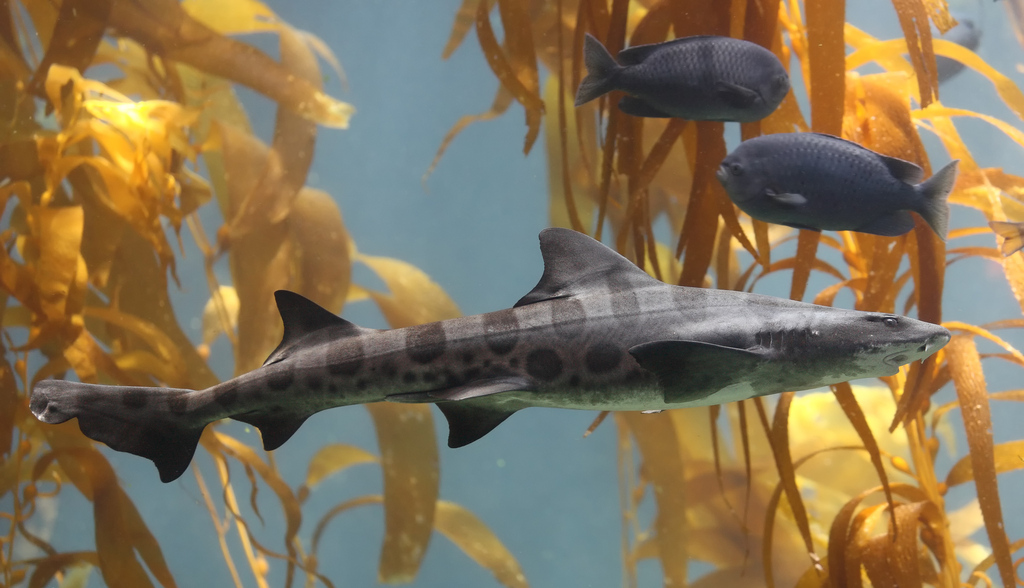
Leopard Shark
Triakis semifasciata
Fishstrong against mammals, arachnids
Common
School
While active with another fish in play, a fish on your bench absorbs up to 9 of the damage this card takes, without being knocked out (18 with two others).
27

31
Leopard Shark
Triakis semifasciata
Fishstrong against mammals, arachnids
Common
While active with another fish in play, a fish on your bench absorbs up to 9 of the damage this card takes, without being knocked out (18 with two others).
Triakis semifasciata
Photo: © Mfield (original photo) · CC BY-SA 4.0 (licence text) · cropped
Strong against: it deals 20% more damage to them. Weak against: these types deal 20% more damage to it.
The leopard shark (Triakis semifasciata) is a species of houndshark, in the family Triakidae. It is found along the Pacific coast of North America, from the U.S. state of Oregon to Mazatlán in Mexico. Typically measuring 1.2–1.5 m (3.9–4.9 ft) long, this slender-bodied shark is immediately identifiable by the striking pattern of black saddle-like markings and large spots over its back, from which it derives its common name. Large schools of leopard sharks are a common sight in bays and estuaries, swimming over sandy or muddy flats or rock-strewn areas near kelp beds and reefs. They are most common near the coast, in water less than 4 m (13 ft) deep.
Active-swimming predators, groups of leopard sharks often follow the tide onto intertidal mudflats to forage for food, mainly clams, spoon worms, crabs, shrimp, bony fish, and fish eggs. Most leopard sharks tend to remain within a particular area rather than undertaking long movements elsewhere, which has led to genetic divergence between populations of sharks living in different regions. This species is aplacental viviparous, meaning that the young hatch inside the uterus and are nourished by yolk. From March to June, the female gives birth to as many as 37 young after a gestation period of 10–12 months. It is relatively slow-growing and takes many years to mature.
Abridged excerpt from the Wikipedia article Leopard shark, by its authors, under the CC BY-SA 4.0 licence.
Least Concern on the IUCN Red List: that’s what makes this card Common.
Every Common card has 100 points, shared between HP, ATK and DEF:
How they’re shared out:

 DEF 31