 …
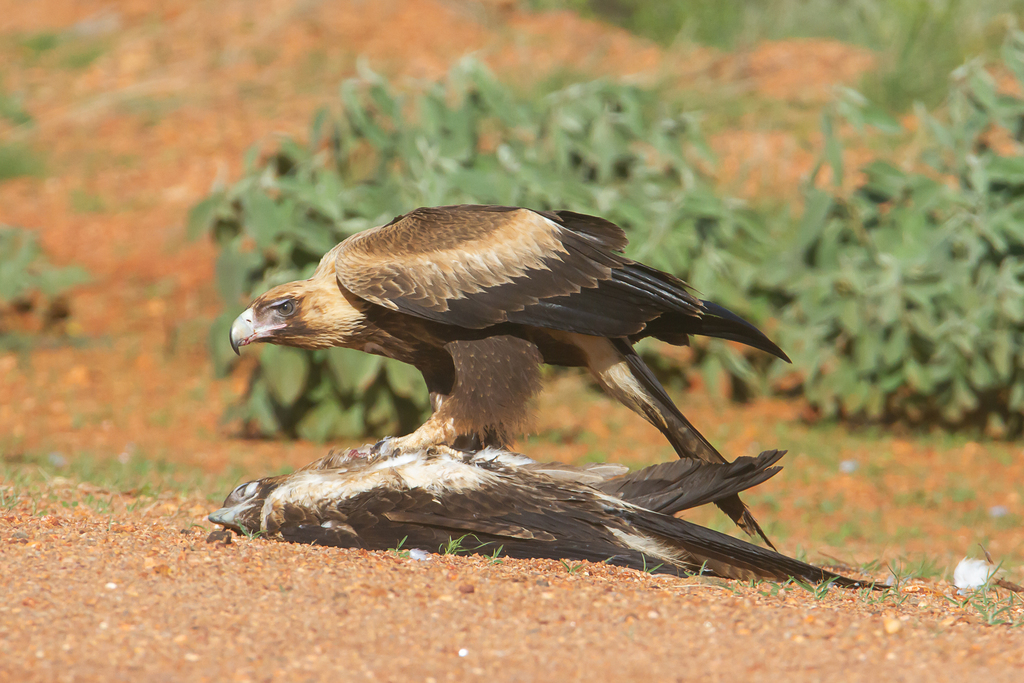
Wedge-tailed Eagle
Aquila audax
Birdstrong against fish, reptiles
Common
Swoop
While active with another bird in play, it hits 6 harder on its first attack after entering play (12 with two others).
28

30
Wedge-tailed Eagle
Aquila audax
Birdstrong against fish, reptiles
Common
While active with another bird in play, it hits 6 harder on its first attack after entering play (12 with two others).
Aquila audax
Photo: © dhfischer (original photo) · CC BY 4.0 (licence text) · cropped
Strong against: it deals 20% more damage to them. Weak against: these types deal 20% more damage to it.
The wedge-tailed eagle (Aquila audax) is the largest bird of prey in the continent of Australia. It is also found in southern New Guinea to the north and is distributed as far south as the state of Tasmania. Adults of the species have long, broad wings, fully feathered legs, an unmistakable, wedge-shaped tail, an elongated upper mandible, a strong beak, and powerful feet. The wedge-tailed eagle is one of 12 species of large, predominantly dark-coloured booted eagles in the genus Aquila found worldwide. Genetic research clearly has indicated that the wedge-tailed eagle is fairly closely related to other, generally large members of the Aquila genus. A large, brown-to-black bird of prey, it has a maximum reported wingspan of 2.84 m (9 ft 4 in) and a length up to 1.06 m (3 ft 6 in).
Wedge-tailed eagles are some of their native continent's most generalised birds of prey. They reside in most habitats present in Australia, ranging from desert and semidesert to plains to mountainous areas to forests, even sometimes tropical rainforests. Their preferred habitats, however, tend towards those that have a fairly varied topography, including rocky areas, some open terrain, and native woodlots such as Eucalyptus stands.
Abridged excerpt from the Wikipedia article Wedge-tailed eagle, by its authors, under the CC BY-SA 4.0 licence.
Least Concern on the IUCN Red List: that’s what makes this card Common.
Every Common card has 100 points, shared between HP, ATK and DEF:
How they’re shared out:

 DEF 30