 …
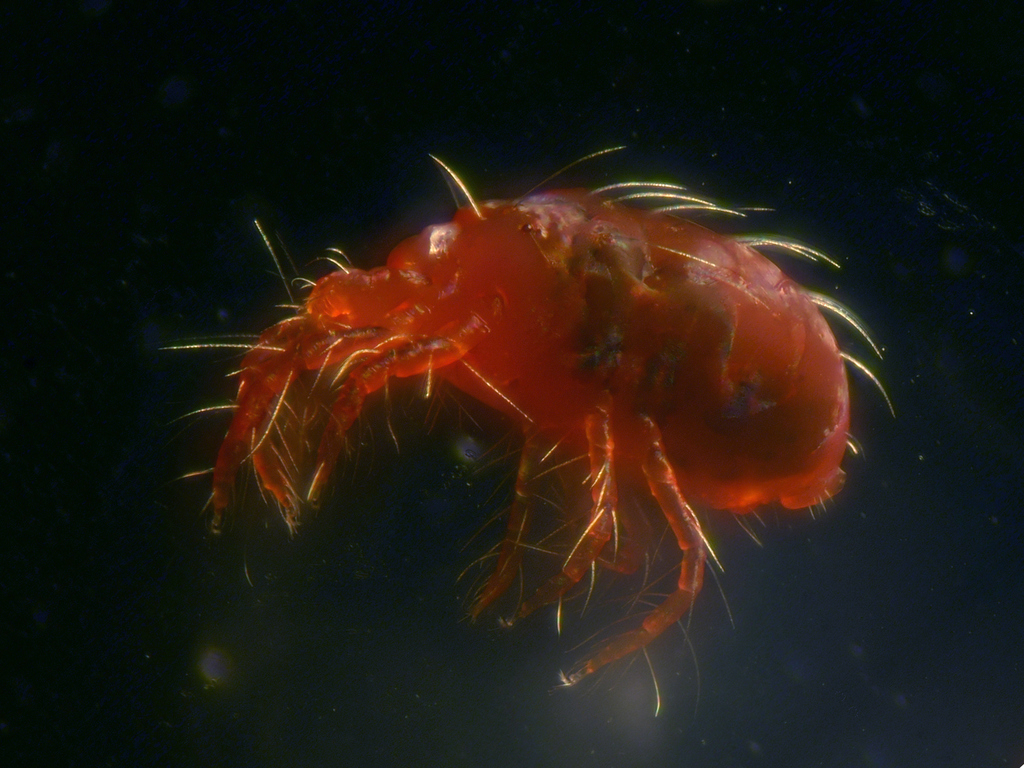
Gorse Spider Mite
Tetranychus lintearius
Arachnidstrong against insects, birds
Common
Venom
While active with another arachnid in play, its target loses 4 HP at the start of each of its turns, as long as it stays active (7 with two others).
40

29
Gorse Spider Mite
Tetranychus lintearius
Arachnidstrong against insects, birds
Common
While active with another arachnid in play, its target loses 4 HP at the start of each of its turns, as long as it stays active (7 with two others).
Tetranychus lintearius
Photo: © Tony Wills (original photo) · CC BY-SA 4.0 (licence text) · cropped
Strong against: it deals 20% more damage to them. Weak against: these types deal 20% more damage to it.
Tetranychus lintearius, the gorse spider mite, is a species of spider mite. It is used as an agent of biological pest control on common gorse, a noxious weed in some countries.
The adult mite is half a millimeter long and bright red. It lives in colonies in a shelter of spun silk spanning many branch tips. Infested plants are easily identifiable by these cobweb-like sheets of silk, which can grow quite large. The female lays one to four eggs per day during her three- to four-week adult lifespan. The tiny nymph is small enough to disperse on the wind during its first stage. Those that stay behind populate the colony as it expands.
This mite is native to Europe, where it does more damage to the plant than any other organism. The mite appears to be host-specific; it does not attack any other plants. The adult and nymph damage the plant by piercing its tissues during feeding. Heavy mite activity reduces flowering and can stunt the development of the branches.
It is widespread in parts of Australia, including Tasmania. It was introduced to the northwestern United States and Hawaii in the 1990s, where it is now established in gorse. The mite has natural predators, including another mite (Phytoseiulus persimilis) and a species of ladybird (Stethorus punctillum), which can severely reduce its population.
Excerpt from the Wikipedia article Tetranychus lintearius, by its authors, under the CC BY-SA 4.0 licence.
No global status on the IUCN Red List: that’s what makes this card Common.
Every Common card has 100 points, shared between HP, ATK and DEF:
How they’re shared out:

 DEF 29