 …
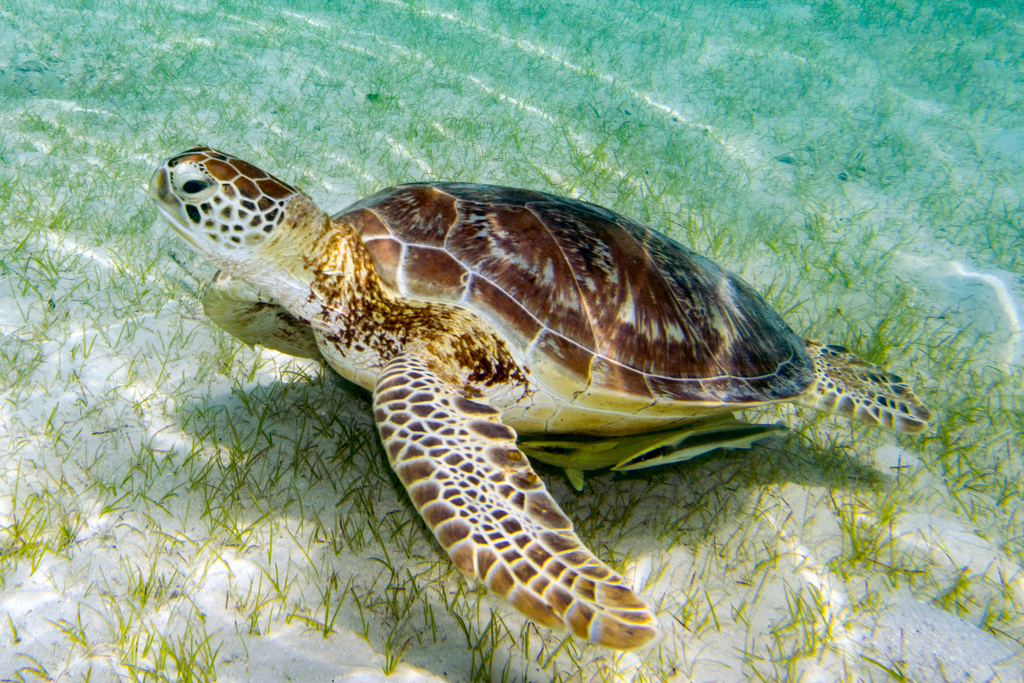
Green Sea Turtle
Chelonia mydas
Reptilestrong against amphibians, mammals
Common
Scales
While active with another reptile in play, it takes 3 less damage (6 with two others).
36

28
Green Sea Turtle
Chelonia mydas
Reptilestrong against amphibians, mammals
Common
While active with another reptile in play, it takes 3 less damage (6 with two others).
Chelonia mydas
Photo: © Paul Asman and Jill Lenoble (original photo) · CC BY 4.0 (licence text) · cropped
Strong against: it deals 20% more damage to them. Weak against: these types deal 20% more damage to it.
The green sea turtle (Chelonia mydas), also known as the green turtle, black sea turtle, and Pacific green turtle, is a species of large sea turtle of the family Cheloniidae. It is the only species in the genus Chelonia. Its range extends throughout tropical and subtropical seas around the world, with two distinct populations in the Atlantic and Pacific Oceans, but it is also found in the Indian Ocean. The common name refers to the usually green fat found beneath its carapace, due to its diet strictly being seagrass, not to the color of its carapace, which is olive to black.
The dorsoventrally flattened body of C. mydas is covered by a large, teardrop-shaped carapace; it has a pair of large, paddle-like flippers. It is usually lightly colored, although in the eastern Pacific populations, parts of the carapace can be almost black. Unlike other members of its family, such as the hawksbill sea turtle, C. mydas is mostly herbivorous. The adults usually inhabit shallow lagoons, feeding mostly on various species of seagrasses. The green sea turtle is the only aquatic turtle species which is herbivorous when fully grown.
Abridged excerpt from the Wikipedia article Green sea turtle, by its authors, under the CC BY-SA 4.0 licence.
Least Concern on the IUCN Red List: that’s what makes this card Common.
Every Common card has 100 points, shared between HP, ATK and DEF:
How they’re shared out:

 DEF 28