 …
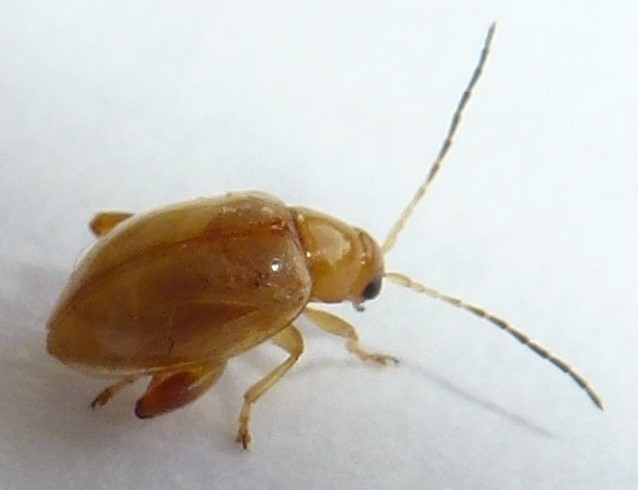
Ragwort Flea Beetle
Longitarsus jacobaeae
Insectstrong against fungi, fish
Common
Swarm
While active with another insect in play, each of its attacks also hits the opposing bench for 10, without knocking them out (20 with two others).
40

39
Ragwort Flea Beetle
Longitarsus jacobaeae
Insectstrong against fungi, fish
Common
While active with another insect in play, each of its attacks also hits the opposing bench for 10, without knocking them out (20 with two others).
Longitarsus jacobaeae
Photo: © Callan Bird (original photo) · CC BY 4.0 (licence text) · cropped
Strong against: it deals 20% more damage to them. Weak against: these types deal 20% more damage to it.
Longitarsus jacobaeae is a species of flea beetle known as the tansy ragwort flea beetle. It is used as an agent of biological pest control against the nectar-rich noxious weed known as ragwort (Senecio jacobaea reclassified as Jacobaea vulgaris).
The adult beetle is light golden brown in color and between 2 millimetres (0.079 in) and 4 millimetres (0.16 in) long. The female is larger than the male, especially when gravid. The beetle has enlarged femurs for its main locomotion method of hopping. The female lays eggs on or near the ragwort, its host plant. The larva emerges in about two weeks and burrows into the ground to feed on the roots. The larvae and adults are dually responsible for damage to the plant. The adult defoliates plants which are often already weakened by larval damage at the roots. This two-pronged attack is quite successful in preventing ragwort growth and development. The beetles have prevented entire populations of ragwort from reaching flowering stage at several monitored sites.
The beetle is not choosy between species in the genera in which it feeds from, and recent studies with the beetle have shown "that selection pressure by specialist herbivores is not likely a driving force in evolutionary diversification" of the plants which contain the alkaloids that the beetle dines on.
This beetle is native to Eurasia. It was first introduced to the United States as a ragwort biocontrol agent in 1969 and it is now established in much of the western United States.
Abridged excerpt from the Wikipedia article Tansy ragwort flea beetle, by its authors, under the CC BY-SA 4.0 licence.
No global status on the IUCN Red List: that’s what makes this card Common.
Every Common card has 100 points, shared between HP, ATK and DEF:
How they’re shared out:

 DEF 39