
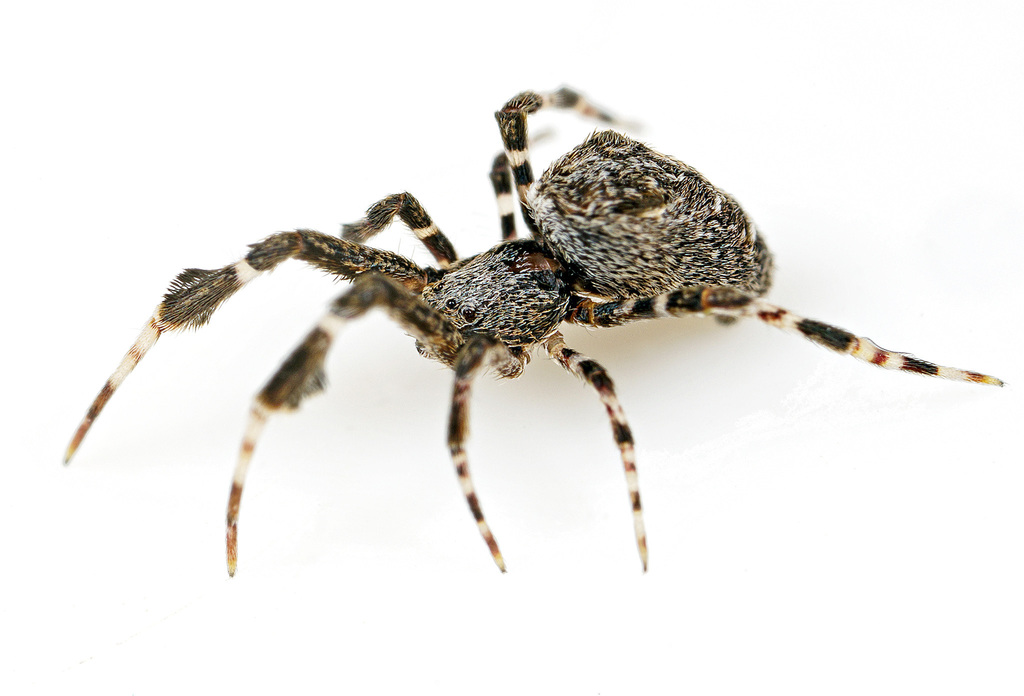
Feather-legged Lace Weaver
Uloborus plumipes
Arachnidstrong against insects, birds
Common
While active with another arachnid in play, its target loses 4 HP at the start of each of its turns, as long as it stays active (7 with two others).

Feather-legged Lace Weaver
Uloborus plumipes
Arachnidstrong against insects, birds
Common
While active with another arachnid in play, its target loses 4 HP at the start of each of its turns, as long as it stays active (7 with two others).
Uloborus plumipes
Photo: © AJC1 (original photo) · CC BY-SA 4.0 (licence text) · cropped
Strong against: it deals 20% more damage to them. Weak against: these types deal 20% more damage to it.
Uloborus plumipes is a species of Old World cribellate spider in the family Uloboridae. Common names include the feather-legged lace weaver and the garden centre spider, the latter name being due to its frequent occurrence of this spider in garden centres. The species name is derived from the Latin pluma "feather" and pes "foot".
Females grow up to 10 mm. They lack venom glands, and are therefore non-venomous. A stabilimentum is sometimes present. Pattern and colouration is quite variable. In contrast to Uloborus walckenaerius, it has distinct tufts of hairs on the front legs. They are well-camouflaged as they hang upside down motionlessly in their horizontal webs. Young spiders look like dead insects and are thus hard to find on a web. The empty egg sac can often be seen attached to house plants. It is flattish, papery and brown and about 0.5 cm long, with the shape of a dried holly leaf.
Excerpt from the Wikipedia article Uloborus plumipes, by its authors, under the CC BY-SA 4.0 licence.
No global status on the IUCN Red List: that’s what makes this card Common.
Every Common card has 100 points, shared between HP, ATK and DEF:
How they’re shared out:

