 …
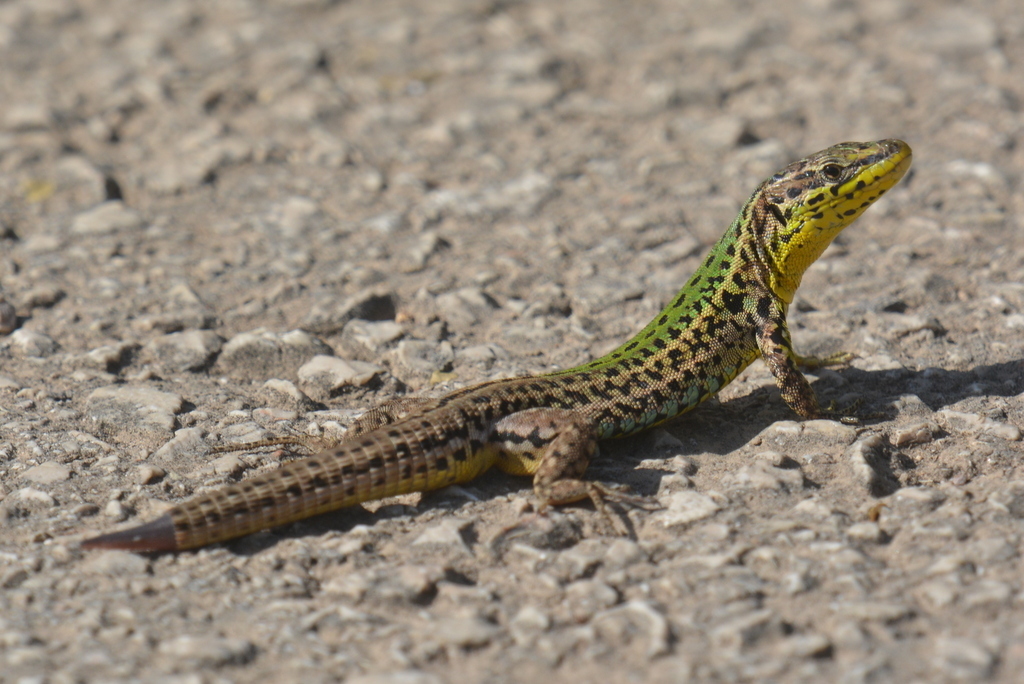
Dalmatian Wall Lizard
Podarcis melisellensis
Reptilestrong against amphibians, mammals
Common
Scales
While active with another reptile in play, it takes 3 less damage (6 with two others).
32

39
Dalmatian Wall Lizard
Podarcis melisellensis
Reptilestrong against amphibians, mammals
Common
While active with another reptile in play, it takes 3 less damage (6 with two others).
Podarcis melisellensis
Photo: Simon Tonge (original photo) · CC0 (licence text) · cropped
Strong against: it deals 20% more damage to them. Weak against: these types deal 20% more damage to it.
The Dalmatian wall lizard (Podarcis melisellensis) is a species of lizard in the family Lacertidae. It is found in Albania, Bosnia and Herzegovina, Croatia, Italy, Serbia, Montenegro, and Slovenia. Its natural habitats are temperate forests, Mediterranean-type shrubby vegetation, rocky areas, and pastureland.
Dalmatian wall lizards grow up to 65 mm (2.6 in) in snout–vent length. Tail is about twice as long as the body. Female lizards lay 2–8 eggs. Juveniles are about 25 mm (0.98 in) in snout–vent length upon hatching.
These lizards display three ventral color morphs: yellow, orange and white. A male that is an orange color morph is seen as a more dominant male than any other morph in intrasexual competition, since the orange color displays the lizard as more aggressive. Orange morph lizards have a larger size and bite force so they can ward off competing males in order to mate with a female of choice and claim territory In this species of lizards, the females prefer the orange males since the orange males are bigger and healthier and can give a female's offspring high quality indirect benefits. Even though females prefer to mate with orange morphs, they will still mate with yellow morphs. Yellow morph lizards give females more direct benefits like protection and small territory than indirect benefits. Meanwhile, white males are only able to mate by intruding on another male's territory and mating with other male's females.
Excerpt from the Wikipedia article Dalmatian wall lizard, by its authors, under the CC BY-SA 4.0 licence.
Least Concern on the IUCN Red List: that’s what makes this card Common.
Every Common card has 100 points, shared between HP, ATK and DEF:
How they’re shared out:

 DEF 39