 …
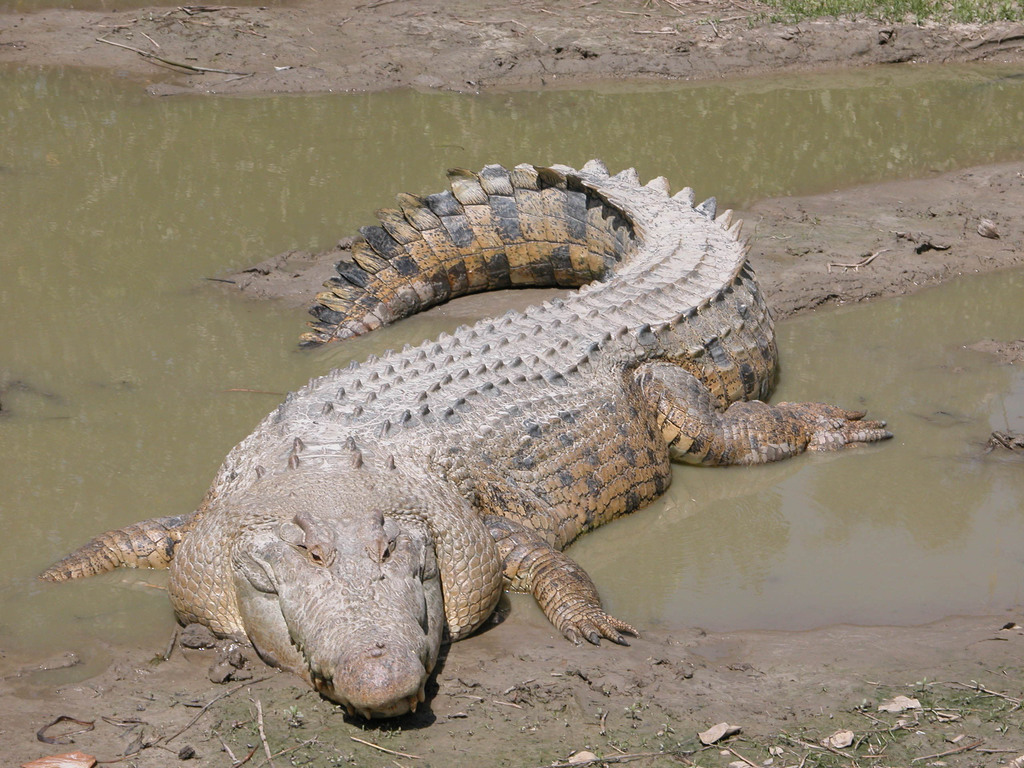
Saltwater Crocodile
Crocodylus porosus
Reptilestrong against amphibians, mammals
Common
Scales
While active with another reptile in play, it takes 3 less damage (6 with two others).
32

25
Saltwater Crocodile
Crocodylus porosus
Reptilestrong against amphibians, mammals
Common
While active with another reptile in play, it takes 3 less damage (6 with two others).
Crocodylus porosus
Photo: Obtained from Molly Ebersold of the St. Augusti… (original photo) · public domain (licence text) · cropped
Strong against: it deals 20% more damage to them. Weak against: these types deal 20% more damage to it.
The saltwater crocodile (Crocodylus porosus) is a crocodilian native to saltwater habitats, brackish wetlands and freshwater rivers from India's east coast across Southeast Asia and the Sundaland to northern Australia and Micronesia. It has been listed as Least Concern on the IUCN Red List since 1996. It was hunted for its skin throughout its range up to the 1970s, and is threatened by illegal killing and habitat loss. It is regarded as dangerous to humans.
The saltwater crocodile is the largest living reptile. Males can grow to a weight of 1,000–1,500 kg (2,200–3,300 lb) and a length of 6 m (20 ft), rarely exceeding 6.3 m (21 ft). Females are much smaller and rarely surpass 3 m (9.8 ft). It is also called the estuarine crocodile, Indo-Pacific crocodile, marine crocodile, sea crocodile, and, informally, the saltie. A large and opportunistic hypercarnivorous apex predator, they ambush most of their prey and then drown or swallow it whole. They will prey on almost any animal that enters their territory, including other predators such as sharks, varieties of freshwater and saltwater fish including pelagic species, invertebrates such as crustaceans, various amphibians, other reptiles, birds, and mammals.
Excerpt from the Wikipedia article Saltwater crocodile, by its authors, under the CC BY-SA 4.0 licence.
Least Concern on the IUCN Red List: that’s what makes this card Common.
Every Common card has 100 points, shared between HP, ATK and DEF:
How they’re shared out:

 DEF 25