 …
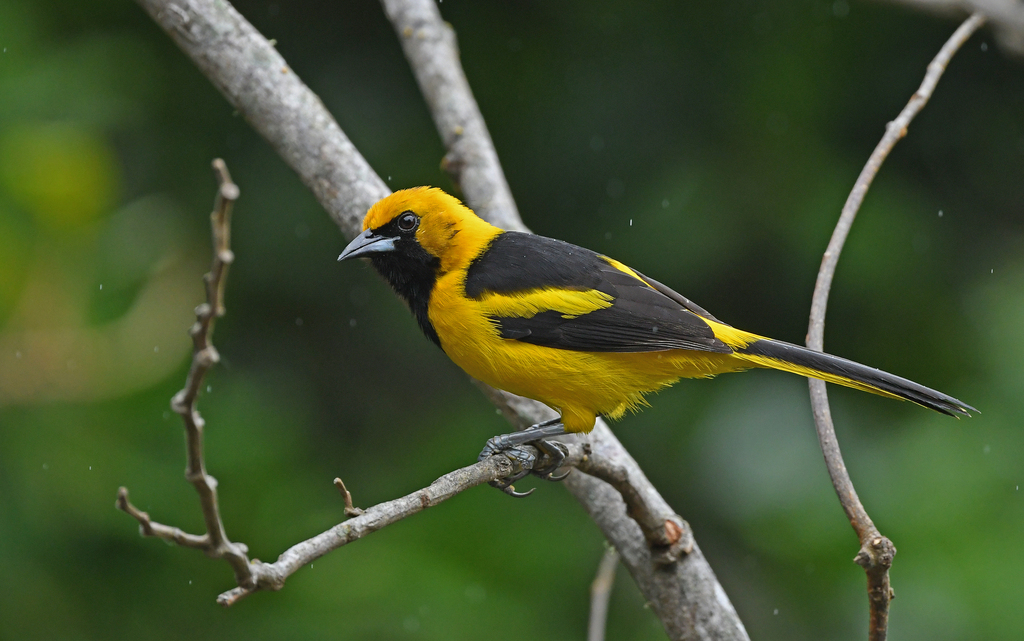
Yellow-tailed Oriole
Icterus mesomelas
Birdstrong against fish, reptiles
Common
Swoop
While active with another bird in play, it hits 6 harder on its first attack after entering play (12 with two others).
38

40
Yellow-tailed Oriole
Icterus mesomelas
Birdstrong against fish, reptiles
Common
While active with another bird in play, it hits 6 harder on its first attack after entering play (12 with two others).
Icterus mesomelas
Photo: © Christoph Moning (original photo) · CC BY 4.0 (licence text) · cropped
Strong against: it deals 20% more damage to them. Weak against: these types deal 20% more damage to it.
The yellow-tailed oriole (Icterus mesomelas) is a passerine bird in the New World family Icteridae. It breeds from southern Mexico to western Peru and northwestern Venezuela; in Peru it also lives in a river valley corridor.
The yellow-tailed oriole is 22–23 cm (8.7–9.1 in) long and weighs 70 g (2.5 oz). It is mainly yellow with a black back, lower face and upper breast. The wings are black with yellow epaulets. The tail, seen from above, is black with yellow margins; from below, it appears almost entirely yellow. This is the only oriole with prominent yellow in the tail, hence the species' name. The sexes are similar, but young birds have the black on the back and tail replaced with olive-green.
There are four subspecies:
Icterus mesomelas mesomelas – (Wagler, 1829): nominate, found from Mexico to Honduras, has yellow fringes to the tertials
Icterus mesomelas salvinii – Cassin, 1867: found in the Caribbean lowlands of Nicaragua and Costa Rica, has no yellow fringes to the tertials and is more orange than the nominate race
Icterus mesomelas carrikeri – Todd, 1917: found in Panama, Colombia and northwestern Venezuela, is like salvinii, but less orange and smaller-billed
Icterus mesomelas taczanowskiis – Ridgway, 1901: found in Pacific South America from Ecuador to western Peru, has white fringes to the tertials
Abridged excerpt from the Wikipedia article Yellow-tailed oriole, by its authors, under the CC BY-SA 4.0 licence.
Least Concern on the IUCN Red List: that’s what makes this card Common.
Every Common card has 100 points, shared between HP, ATK and DEF:
How they’re shared out:

 DEF 40