 …
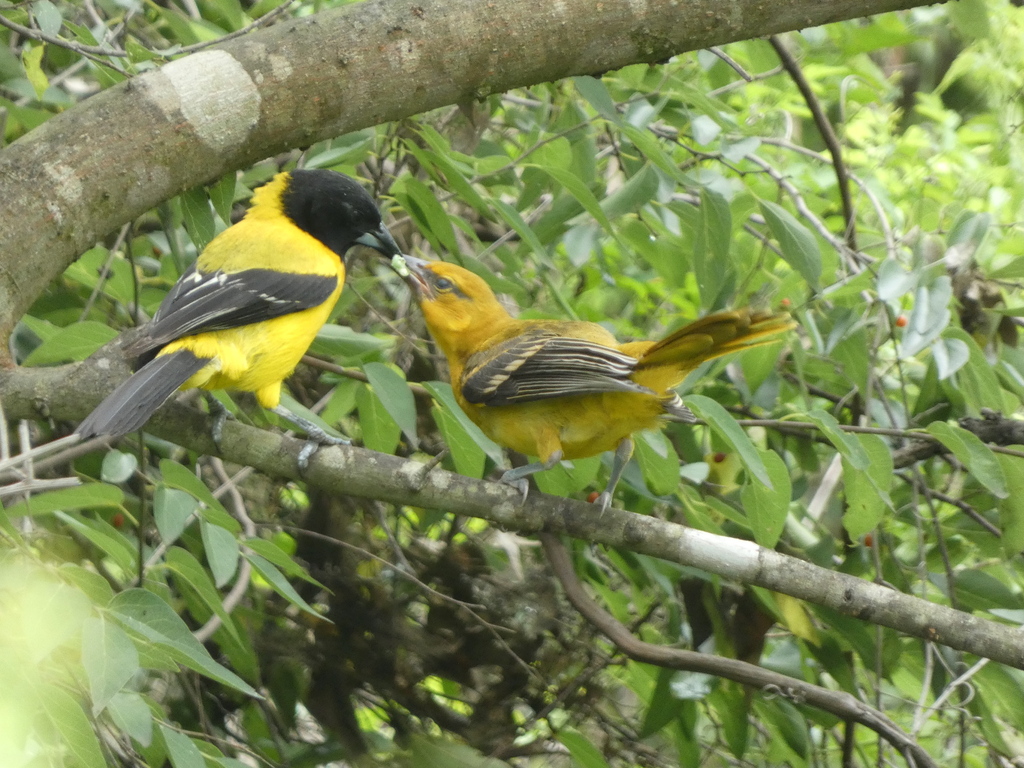
Audubon's Oriole
Icterus graduacauda
Birdstrong against fish, reptiles
Common
Swoop
While active with another bird in play, it hits 6 harder on its first attack after entering play (12 with two others).
41

39
Audubon's Oriole
Icterus graduacauda
Birdstrong against fish, reptiles
Common
While active with another bird in play, it hits 6 harder on its first attack after entering play (12 with two others).
Icterus graduacauda
Photo: © datadan (original photo) · CC BY 4.0 (licence text) · cropped
Strong against: it deals 20% more damage to them. Weak against: these types deal 20% more damage to it.
Audubon's oriole (Icterus graduacauda), formerly known as the black-headed oriole, is a New World passerine inhabiting the forests and thickets of southeastern Texas and the Mexican coast. It is the only species to have a black hood and yellow body. It is divided into four subspecies and two allopatric breeding ranges. The westernmost range extends from Nayarit south to southern Oaxaca, whereas the eastern range stretches from the lower Rio Grande valley to northern Querétaro. The most common in the western range are the subspecies I. g. dickeyae and I. g. nayaritensis; I. g. graduacauda and I. g. audubonii can be found in the eastern range. Like most Central American birds, it is not a migratory species and does not display significant sexual dimorphism. DNA analysis of the ND2 and cyt-b genes strongly suggests that I. graduacauda is most closely related to I. chrysater, the yellow-backed oriole. It is a member of the genus Icterus and therefore should not be confused with the Old World orioles.
Excerpt from the Wikipedia article Audubon's oriole, by its authors, under the CC BY-SA 4.0 licence.
Least Concern on the IUCN Red List: that’s what makes this card Common.
Every Common card has 100 points, shared between HP, ATK and DEF:
How they’re shared out:

 DEF 39