 …
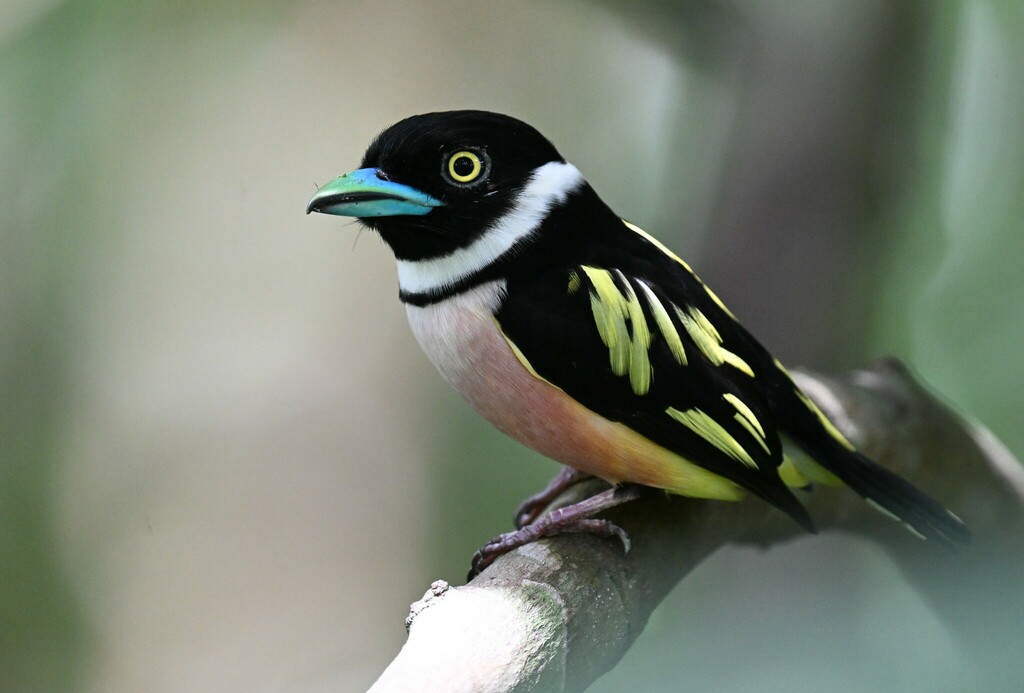
Black-and-yellow Broadbill
Eurylaimus ochromalus
Birdstrong against fish, reptiles
Uncommon
Swoop
While active with another bird in play, it hits 6 harder on its first attack after entering play (12 with two others).
35

45
Black-and-yellow Broadbill
Eurylaimus ochromalus
Birdstrong against fish, reptiles
Uncommon
While active with another bird in play, it hits 6 harder on its first attack after entering play (12 with two others).
Eurylaimus ochromalus
Photo: iNaturalist (original photo) · CC0 (licence text) · cropped
Strong against: it deals 20% more damage to them. Weak against: these types deal 20% more damage to it.
The black-and-yellow broadbill (Eurylaimus ochromalus) is a species of bird in the typical broadbill family Eurylaimidae. A small, distinctive species, it has a black head, breastband, and upperparts, a white neckband, yellow streaking on the back and wings, and vinous-pink underparts that turn yellow towards the belly. The beak is bright blue, with a green tip to the upper mandible and black edges. It shows some sexual dimorphism, with the black breastband being incomplete in females.
Native to Brunei, Indonesia, Malaysia, Myanmar, Singapore, and Thailand, it inhabits evergreen forest, dipterocarp forest, swamp forest, heath forest, and forest edge, along with secondary forest and plantations that contain large trees. Mainly inhabiting lowlands, the species is found up to elevations of 1,220 m (4,000 ft). The black-and-yellow broadbill is mainly insectivorous, but also feeds on molluscs and incidentally takes fruit.
The black-and-yellow broadbill breeds during the dry season throughout its range, with both sexes helping build a large, untidy, pear-shaped nest out of moss, fungal mycelia, and leaves. Eggs are laid in clutches of two or three, sometimes containing a fourth runt egg, and are incubated by both sexes. The species is listed as near-threatened by the IUCN because of a decline in its population caused by habitat loss.
Excerpt from the Wikipedia article Black-and-yellow broadbill, by its authors, under the CC BY-SA 4.0 licence.
Near Threatened on the IUCN Red List: that’s what makes this card Uncommon.
Every Uncommon card has 115 points, shared between HP, ATK and DEF:
How they’re shared out:

 DEF 45