 …
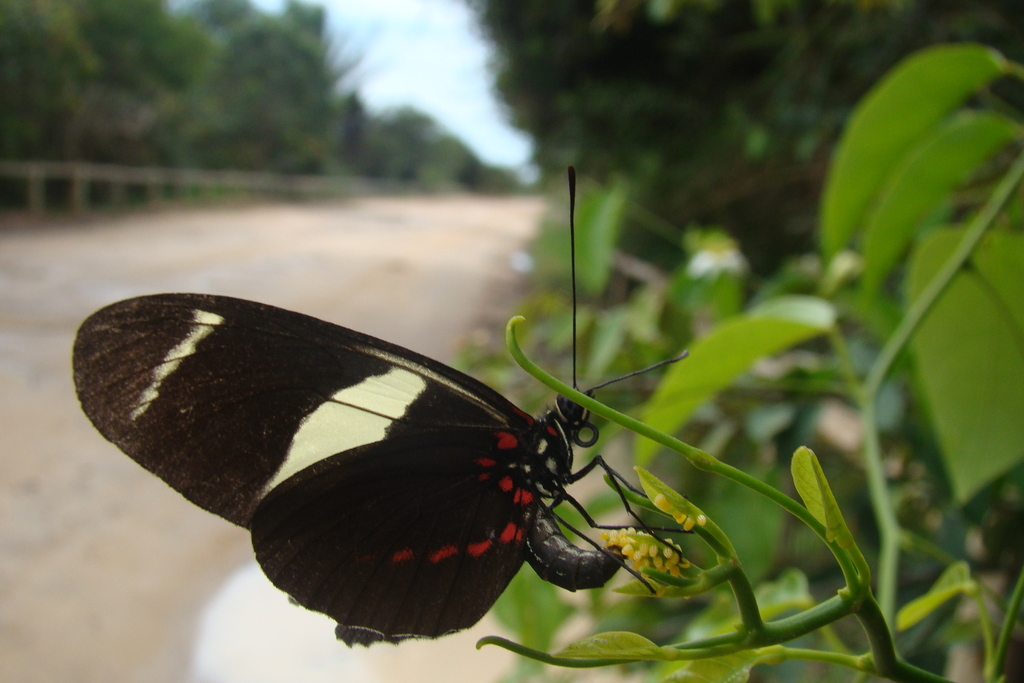
Sara Longwing
Heliconius sara
Insectstrong against fungi, fish
Common
Swarm
While active with another insect in play, each of its attacks also hits the opposing bench for 10, without knocking them out (20 with two others).
39

37
Sara Longwing
Heliconius sara
Insectstrong against fungi, fish
Common
While active with another insect in play, each of its attacks also hits the opposing bench for 10, without knocking them out (20 with two others).
Heliconius sara
Photo: © Lucas Kaminski (original photo) · CC BY 4.0 (licence text) · cropped
Strong against: it deals 20% more damage to them. Weak against: these types deal 20% more damage to it.
The Sara longwing (Heliconius sara) is a species of neotropical heliconiid butterfly found from Mexico to the Amazon Basin and southern Brazil. It is a colourful species: the dorsal wing surface is black with a large medial patch of metallic blue that is framed by two bands of white on the forewings. (This coloration is similar to that of Wallace's longwing, H. wallacei, whose range overlaps Sara's, but does not extend as far north.) The ventral wing surface is a dull brown to black with muted bands and small red spots on the proximal margin; total wingspan is 55–60 mm.
Inhabiting rainforests, adults are commonly found among sparser secondary growth and along forest margins. They feed on the nectar of Hamelia, Lantana, Palicourea, and Psiguria plants. They reproduce continuously, with several generations produced every year. Sara longwings are one of several heliconiids exhibiting the unusual practice of pupal mating, in which adult males are attracted to female pupae via the latter's pheromones. The males compete for prime perch space close to the females' chrysalids, and successful suitors forcibly mate with the females immediately following their emergence. Alternatively, males may also patrol a territory in which they search for females that have already emerged. The adult stage has a lifespan of 2–3 months.
Abridged excerpt from the Wikipedia article Sara longwing, by its authors, under the CC BY-SA 4.0 licence.
No global status on the IUCN Red List: that’s what makes this card Common.
Every Common card has 100 points, shared between HP, ATK and DEF:
How they’re shared out:

 DEF 37