 …
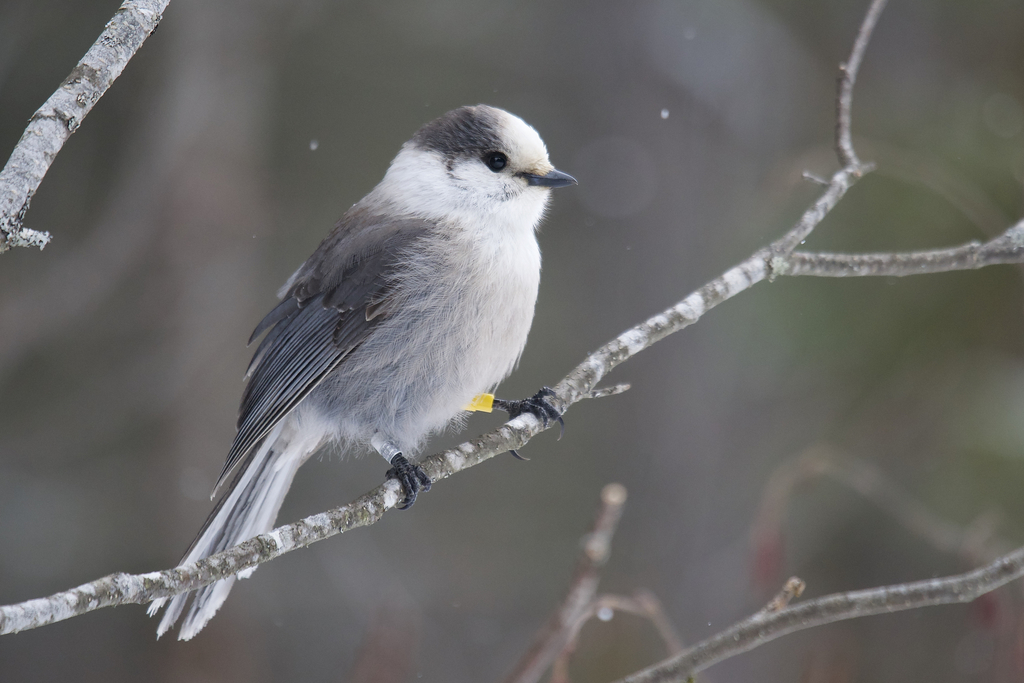
Canada Jay
Perisoreus canadensis
Birdstrong against fish, reptiles
Common
Swoop
While active with another bird in play, it hits 6 harder on its first attack after entering play (12 with two others).
31

36
Canada Jay
Perisoreus canadensis
Birdstrong against fish, reptiles
Common
While active with another bird in play, it hits 6 harder on its first attack after entering play (12 with two others).
Perisoreus canadensis
Photo: © Owen Strickland (original photo) · CC BY 4.0 (licence text) · cropped
Strong against: it deals 20% more damage to them. Weak against: these types deal 20% more damage to it.
The Canada jay (Perisoreus canadensis), also known as the grey jay, gray jay, camp robber, moose bird, gorby, or whisky jack, is a passerine bird of the family Corvidae. It is found in boreal forests of North America, north to the tree line, and in the Rocky Mountains subalpine zone south to New Mexico and Arizona. A fairly large songbird, the Canada jay has pale grey underparts, darker grey upperparts, and a grey-white head with a darker grey nape. It is one of three members of the genus Perisoreus, a genus more closely related to the magpie genus Cyanopica than to other birds known as jays. The Canada jay itself has nine recognized subspecies.
Canada jays live year-round on permanent territories in coniferous forests, surviving in winter months on food cached throughout their territory in warmer periods. The birds form monogamous mating pairs, with pairs accompanied on their territories by a third juvenile from the previous season. Canada jays adapt to human activity in their territories and are known to approach humans for food, inspiring a list of colloquial names including "lumberjack", "camp robber", and "venison-hawk". The International Union for Conservation of Nature (IUCN) considers the Canada jay a least-concern species, but populations in southern ranges may be affected adversely by global warming.
Abridged excerpt from the Wikipedia article Canada jay, by its authors, under the CC BY-SA 4.0 licence.
Least Concern on the IUCN Red List: that’s what makes this card Common.
Every Common card has 100 points, shared between HP, ATK and DEF:
How they’re shared out:

 DEF 36