 …
Western Sheep Moth
Hemileuca eglanterina
Insectstrong against fungi, fish
Common
Swarm
While active with another insect in play, each of its attacks also hits the opposing bench for 10, without knocking them out (20 with two others).
40

36
Western Sheep Moth
Hemileuca eglanterina
Insectstrong against fungi, fish
Common
While active with another insect in play, each of its attacks also hits the opposing bench for 10, without knocking them out (20 with two others).
Hemileuca eglanterina
Photo: © Don Loarie (original photo) · CC BY 4.0 (licence text) · cropped
Strong against: it deals 20% more damage to them. Weak against: these types deal 20% more damage to it.
The sheep moth, or common sheep moth (Hemileuca eglanterina), is a member of the family Saturniidae of silk moths and is native to western North America. In California, its range is west of the Sierran crest and the mountains of Southern California, ranging near to the coast. The moth is dayflying and appears in summer. It feeds on plants of three genera: Ceanothus, Rhamnus (including coffeeberry), and Rosa. Nuttall's sheep moth and one other species are similar, occurring in sagebrush areas east of the Sierra Nevada. The species was first described by Jean Baptiste Boisduval in 1852.
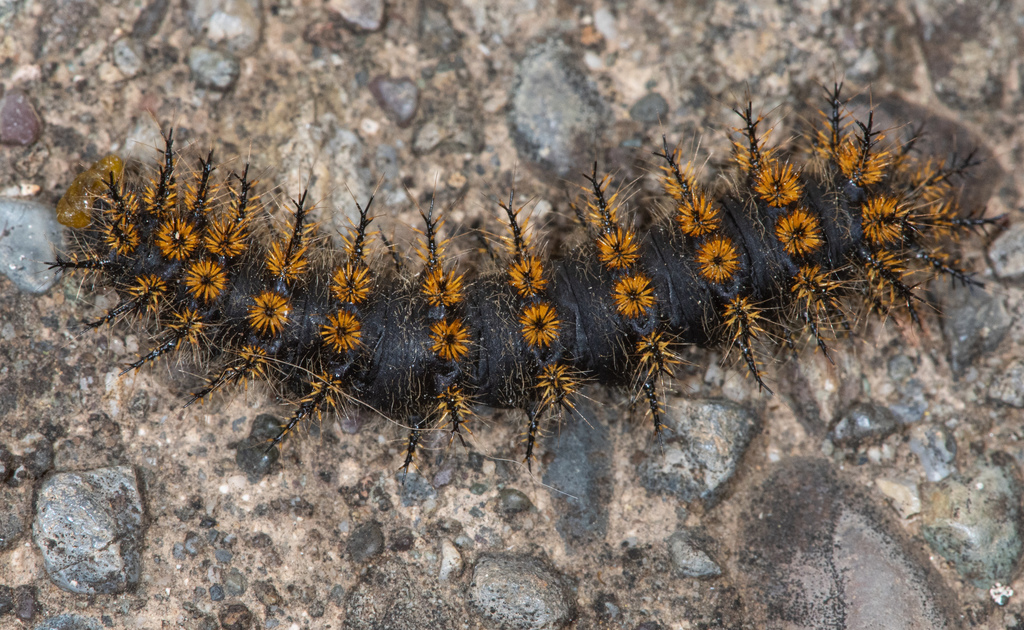
The sheep moth has a 5.5-8.5 centimeter wingspan and a relatively slender body. Its forewings are pink with a yellow streak in the middle and the hindwings are yellowish with variable black markings. There is an all-black form near Mount Shasta. The larvae are black with branched yellowish spines that become orange in later development and an orange-brown head.
Excerpt from the Wikipedia article Sheep moth, by its authors, under the CC BY-SA 4.0 licence.
No global status on the IUCN Red List: that’s what makes this card Common.
Every Common card has 100 points, shared between HP, ATK and DEF:
How they’re shared out:

 DEF 36