 …
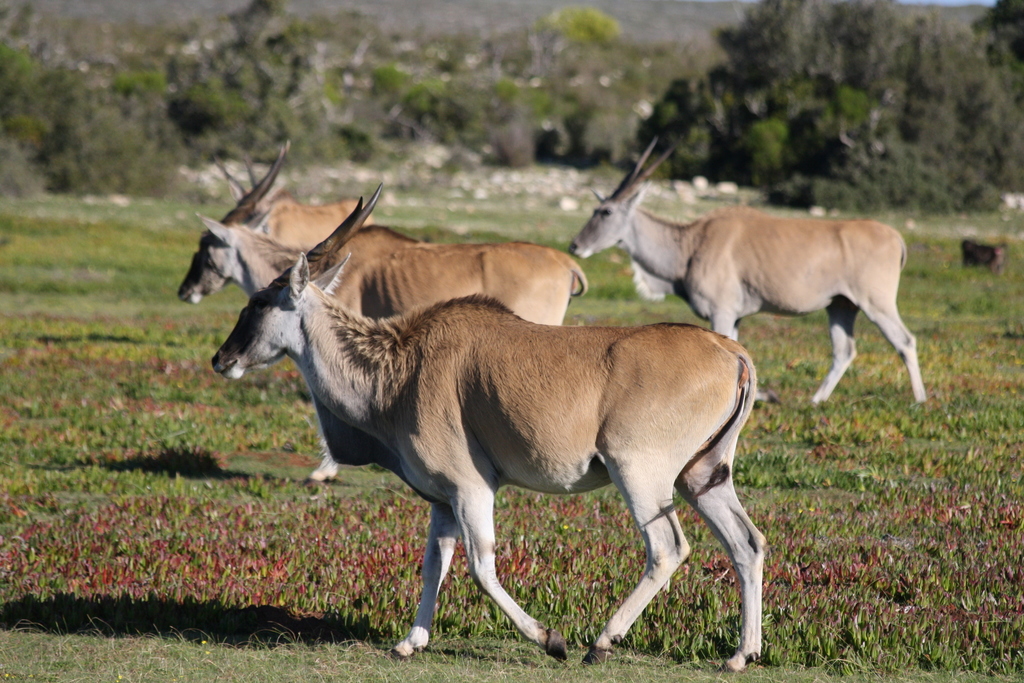
Common Eland
Tragelaphus oryx
Mammalstrong against birds, fungi
Common
Pack
While active with another mammal in play, it hits 7 harder (14 with two others).
33

30
Common Eland
Tragelaphus oryx
Mammalstrong against birds, fungi
Common
While active with another mammal in play, it hits 7 harder (14 with two others).
Tragelaphus oryx
Photo: © Rhonda Ridley (original photo) · CC BY-SA 4.0 (licence text) · cropped
Strong against: it deals 20% more damage to them. Weak against: these types deal 20% more damage to it.
The common eland (Tragelaphus oryx), also known as the southern eland or eland antelope, is a large savannah and plains antelope found in East and Southern Africa. An adult male is around 1.6 m (5.2 ft) tall at the shoulder and can weigh up to 942 kg (2,077 lb) with a typical range of 500–600 kg (1,100–1,300 lb). Females are around 1.4 m (4.6 ft) tall and weigh 340–445 kg (750–981 lb). It was scientifically described by Peter Simon Pallas in 1766.
Mainly a herbivore, its diet is primarily grasses and leaves. Common elands form herds of up to 500 animals, but are not territorial. The common eland prefers habitats with a wide variety of flowering plants such as savannah, woodlands, and open and montane grasslands; it avoids dense forests. It uses loud barks, visual and postural movements, and the flehmen response to communicate and warn others of danger. The common eland is used by humans for leather and meat, and has been domesticated in southern Africa. Eland milk contains more butterfat than cow's milk, and can be stored for up to eight months.
It is native to Angola, Botswana, the Democratic Republic of the Congo, Eswatini, Ethiopia, Kenya, Lesotho, Malawi, Mozambique, Namibia, Rwanda, South Africa, South Sudan, Tanzania, Uganda, Zambia, and Zimbabwe, but is no longer present in Burundi. While the common eland's population is decreasing, it is classified as of least concern by the International Union for Conservation of Nature.
Excerpt from the Wikipedia article Common eland, by its authors, under the CC BY-SA 4.0 licence.
Least Concern on the IUCN Red List: that’s what makes this card Common.
Every Common card has 100 points, shared between HP, ATK and DEF:
How they’re shared out:

 DEF 30