 …
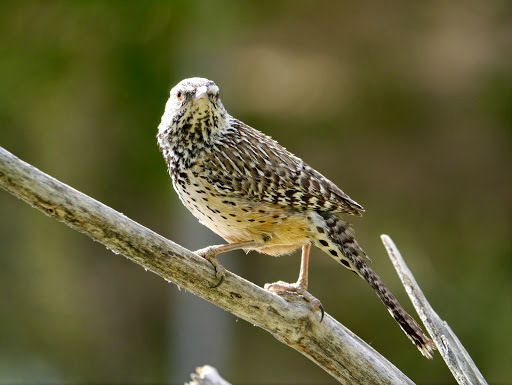
Cactus Wren
Campylorhynchus brunneicapillus
Birdstrong against fish, reptiles
Common
Swoop
While active with another bird in play, it hits 6 harder on its first attack after entering play (12 with two others).
32

35
Cactus Wren
Campylorhynchus brunneicapillus
Birdstrong against fish, reptiles
Common
While active with another bird in play, it hits 6 harder on its first attack after entering play (12 with two others).
Campylorhynchus brunneicapillus
Photo: © 116916927065934112165 (original photo) · CC BY 4.0 (licence text) · cropped
Strong against: it deals 20% more damage to them. Weak against: these types deal 20% more damage to it.
The cactus wren (Campylorhynchus brunneicapillus) is a species of wren that is endemic to the deserts of the southwestern United States and northern and central Mexico. It is the state bird of Arizona, and the largest wren in the United States. Its plumage is brown, with black and white spots as markings. It has a distinctive white eyebrow that sweeps to the nape of the neck. The chest is white, whereas the underparts are cinnamon-buff colored. Both sexes appear similar. The tail, as well as flight feathers, are barred in black and white. Their song is a loud raspy chirrup; akin in the description of some ornithologists to the sound of a car engine that will not start. It is well-adapted to its native desert environment, and the birds can meet their water needs from their diet which consists chiefly of insects, but also of some plant matter. The cactus wren is a poor flier and generally forages for food on the ground. Ornithologists generally recognize seven subspecies, with the exact taxonomy under dispute.
Abridged excerpt from the Wikipedia article Cactus wren, by its authors, under the CC BY-SA 4.0 licence.
Least Concern on the IUCN Red List: that’s what makes this card Common.
Every Common card has 100 points, shared between HP, ATK and DEF:
How they’re shared out:

 DEF 35