 …
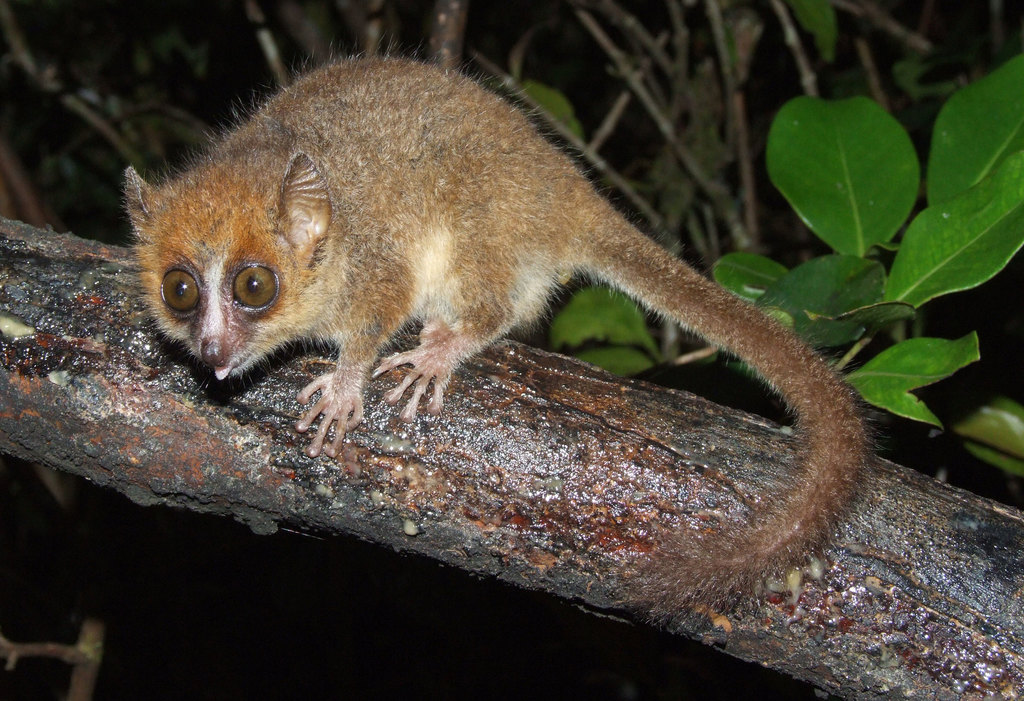
Peters’ Mouse Lemur
Microcebus myoxinus
Mammalstrong against birds, fungi
Rare
Pack
While active with another mammal in play, it hits 7 harder (14 with two others).
37

53
Peters’ Mouse Lemur
Microcebus myoxinus
Mammalstrong against birds, fungi
Rare
While active with another mammal in play, it hits 7 harder (14 with two others).
Microcebus myoxinus
Photo: Bikeadventure (original photo) · public domain (licence text) · cropped
Strong against: it deals 20% more damage to them. Weak against: these types deal 20% more damage to it.
The pygmy mouse lemur (Microcebus myoxinus), also known as Peters' mouse lemur or dormouse lemur, is a primate weighing only 43–55 g (1.5–1.9 oz); it is the second smallest of the mouse lemurs. Its dorsal side is a rufous-brown colour, and creamy-white ventrally. It lives in dry deciduous forests of western Madagascar. It has been captured in the Tsingy de Bemaraha Nature Reserve, the Andramasy forests north of Belo sur Tsiribihina, and the border of heavily degraded deciduous forest and savanna at Aboalimena. It has also been found in other habitats, in mangroves in two localities.
Accounts and descriptions of this species are frequently confounded with those of Microcebus berthae, the smallest primate in the world. This is because specimens of M. berthae captured in Kirindy Forest, 60 km north of Morondava, were erroneously named M. myoxinus. Apparently, the rufous color of M. berthae (not described at the time) matched the description by Peter as M. myoxinus. Most articles on the web report information on M. myoxinus that correspond to studies made in Kirindy Forest on M. berthae.
The behavior and ecology of Microcebus myoxinus remains to be studied in the wild.
The pygmy mouse lemur measures around 12–13 cm (4.7–5.1 in) (head-body length).
Excerpt from the Wikipedia article Pygmy mouse lemur, by its authors, under the CC BY-SA 4.0 licence.
Vulnerable on the IUCN Red List: that’s what makes this card Rare.
Every Rare card has 130 points, shared between HP, ATK and DEF:
How they’re shared out:

 DEF 53