 …
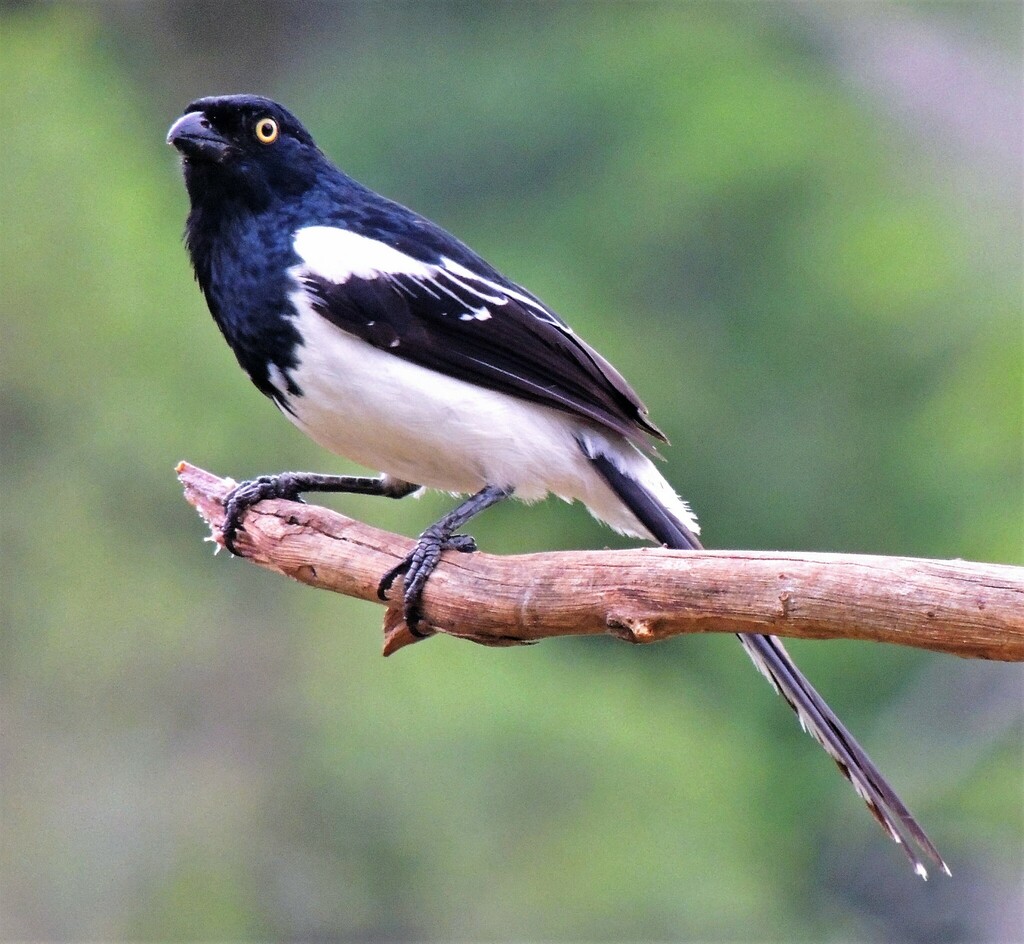
Magpie Tanager
Cissopis leverianus
Birdstrong against fish, reptiles
Common
Swoop
While active with another bird in play, it hits 6 harder on its first attack after entering play (12 with two others).
38

40
Magpie Tanager
Cissopis leverianus
Birdstrong against fish, reptiles
Common
While active with another bird in play, it hits 6 harder on its first attack after entering play (12 with two others).
Cissopis leverianus
Photo: Hugo Hulsberg (original photo) · CC0 (licence text) · cropped
Strong against: it deals 20% more damage to them. Weak against: these types deal 20% more damage to it.
The magpie tanager (Cissopis leverianus) is a South American species of tanager. It is the only member of the monotypic genus Cissopis. As suggested by its common name, this blue-black and white species is superficially reminiscent of a European magpie. With a total length of 25–30 cm (9.8–11.8 in), a large percentage of which is tail, it is the longest species of tanager. It weighs 69–76 g (2.4–2.7 oz).
It is widespread in humid tropical and subtropical woodland, plantations, second growth, and parks in South America east of the Andes. It is absent from drier regions (such as the Caatinga) and most of north-eastern Brazil. In densely forested regions, it mainly occurs in relatively open sections (such as near major rivers). In such regions it is spreading with deforestation, which opens up the habitat. It is largely restricted to lowlands, but occurs up to an altitude of 2,000 m (6,600 ft) on the east Andean slopes. It is common throughout most of its range, but rarer in the Guianas.
It typically occurs in conspicuous, noisy pairs or groups of up to 10 individuals and commonly takes part in mixed-species flocks. It often moves its long tail up and down. It eats seeds, fruits, and insects. The cup-shaped nest is lined with grass, leaves, or other plant materials and is located low in trees near the ground or in shrubs in dense vegetation. The 2 eggs are reddish-brown with brown spots. The incubation time is 12–13 days in captivity.
Excerpt from the Wikipedia article Magpie tanager, by its authors, under the CC BY-SA 4.0 licence.
Least Concern on the IUCN Red List: that’s what makes this card Common.
Every Common card has 100 points, shared between HP, ATK and DEF:
How they’re shared out:

 DEF 40