 …
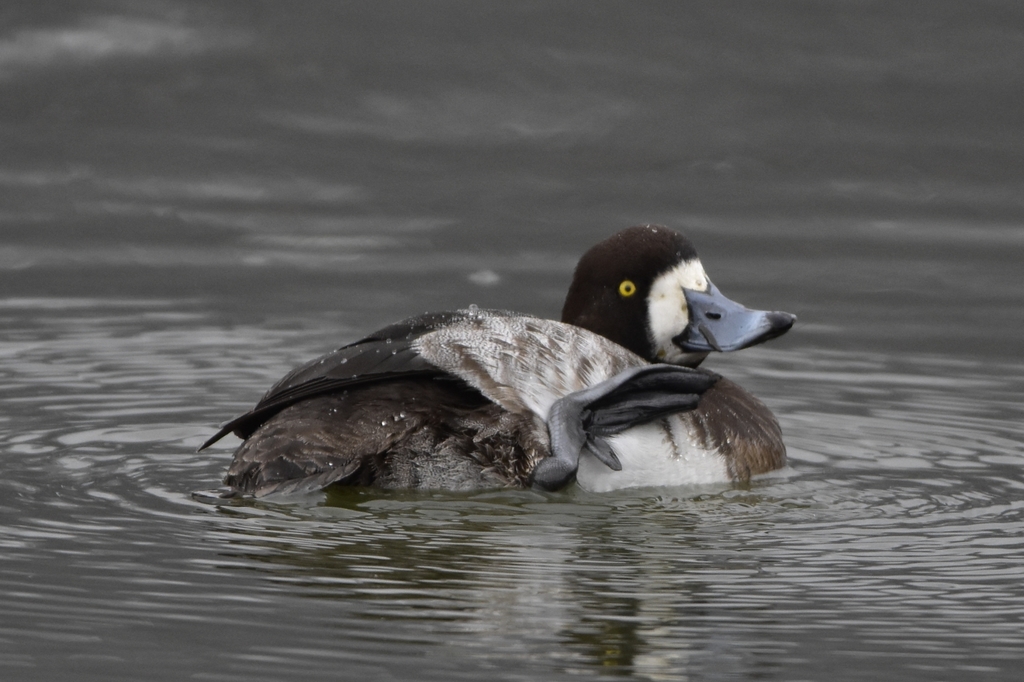
Greater Scaup
Aythya marila
Birdstrong against fish, reptiles
Common
Swoop
While active with another bird in play, it hits 6 harder on its first attack after entering play (12 with two others).
32

36
Greater Scaup
Aythya marila
Birdstrong against fish, reptiles
Common
While active with another bird in play, it hits 6 harder on its first attack after entering play (12 with two others).
Aythya marila
Photo: © Валерия Ковалева (original photo) · CC BY 4.0 (licence text) · cropped
Strong against: it deals 20% more damage to them. Weak against: these types deal 20% more damage to it.
The greater scaup (Aythya marila), just scaup in Europe or, colloquially, "bluebill" in North America, is a mid-sized diving duck, larger than the closely related lesser scaup and tufted duck. It spends the summer months breeding in Iceland, east across Scandinavia, northern Russia and Siberia, Alaska, and northern Canada. During the winter, it migrates south to the coasts of Europe, eastern Asia, and North America.
Male greater scaup average slightly larger than the females but with much overlap; they have a light blue-grey bill and yellow eyes. Their heads are dark, with a green to purple (depending on light angle) gloss; the breast is black, the belly white, the upperparts pale grey, and the wing shows a strong white stripe. The females are mostly brown, again with white on the wing. They have dull blue bills and a white patch on the face.
Greater scaup nest near water, typically on islands in northern lakes or on floating mats of vegetation. They begin breeding at age two, but start building nests in the first year. The drakes have a complex courtship, which takes place on the return migration to the summer breeding grounds and concludes with the formation of monogamous pairs. Females lay a clutch of six to nine olive-buff-coloured eggs. The eggs hatch in 24 to 28 days. The down-covered ducklings are able to follow their mother in her search for food immediately after hatching.
Abridged excerpt from the Wikipedia article Greater scaup, by its authors, under the CC BY-SA 4.0 licence.
Least Concern on the IUCN Red List: that’s what makes this card Common.
Every Common card has 100 points, shared between HP, ATK and DEF:
How they’re shared out:

 DEF 36