 …
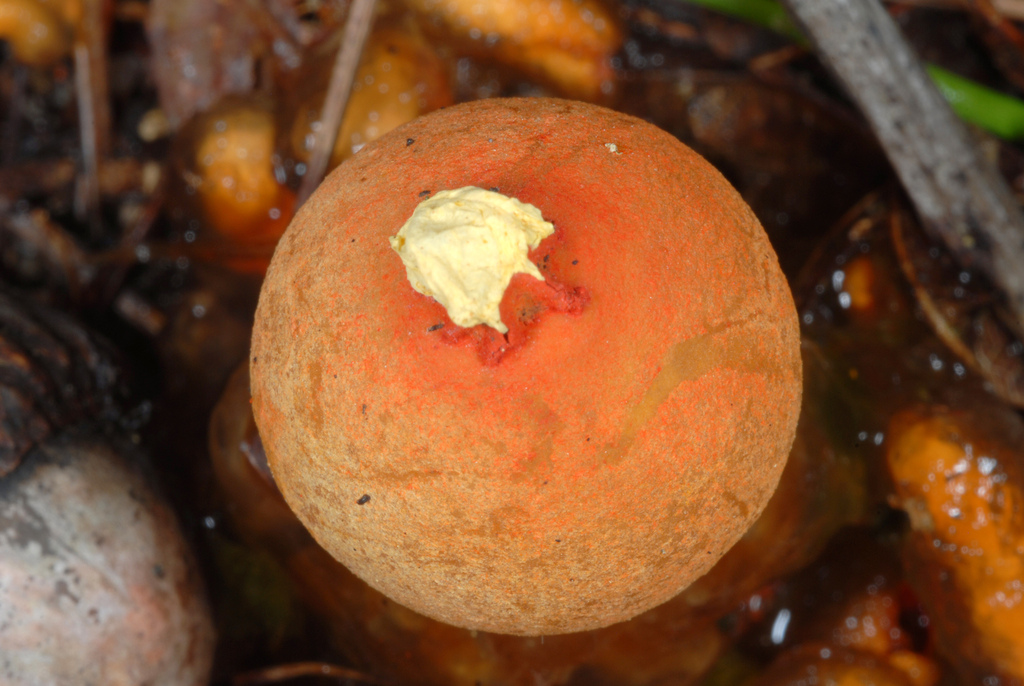
stalked puffball-in-aspic
Calostoma cinnabarinum
Fungusstrong against amphibians, reptiles
Common
Mycelium
While active with another fungus in play, it regains 5 HP at the start of your turn (8 with two others).
41

28
stalked puffball-in-aspic
Calostoma cinnabarinum
Fungusstrong against amphibians, reptiles
Common
While active with another fungus in play, it regains 5 HP at the start of your turn (8 with two others).
Calostoma cinnabarinum
Photo: © Douglas Goldman (original photo) · CC BY-SA 4.0 (licence text) · cropped
Strong against: it deals 20% more damage to them. Weak against: these types deal 20% more damage to it.
Calostoma cinnabarinum, commonly known as the red slimy-stalked puffball, stalked puffball-in-aspic, or gelatinous stalked-puffball, is a species of gasteroid fungus in the family Sclerodermataceae. It is the type species of the genus Calostoma. Despite its appearance and common name, C. cinnabarinum is not related to the true puffballs, members of Podaxis (also commonly called "stalked puffballs"), earthstars or stinkhorns. However, during its complex taxonomic history, it has variously been confused it with each of those groups, prior to the advent of molecular phylogenetics.
The fruit body has a distinctive color and overall appearance, featuring a layer of yellowish jelly surrounding a bright red, spherical head approximately 2 centimeters (0.8 in) in diameter atop a red or yellowish brown spongy stipe 1.5 to 4 cm (0.6 to 2 in) tall. The innermost layer of the head is the gleba, containing clear or slightly yellowish elliptical spores, measuring 14–20 micrometers (μm) long by 6–9 μm across. The spore surface features a pattern of small pits, producing a net-like appearance. It is distributed in the Americas and East Asia, where it grows on the ground in deciduous forests, forming mycorrhizal associations with oaks. Although eaten or used in folk medicine in some areas, it is typically considered inedible.
Excerpt from the Wikipedia article Calostoma cinnabarinum, by its authors, under the CC BY-SA 4.0 licence.
Least Concern on the IUCN Red List: that’s what makes this card Common.
Every Common card has 100 points, shared between HP, ATK and DEF:
How they’re shared out:

 DEF 28