 …
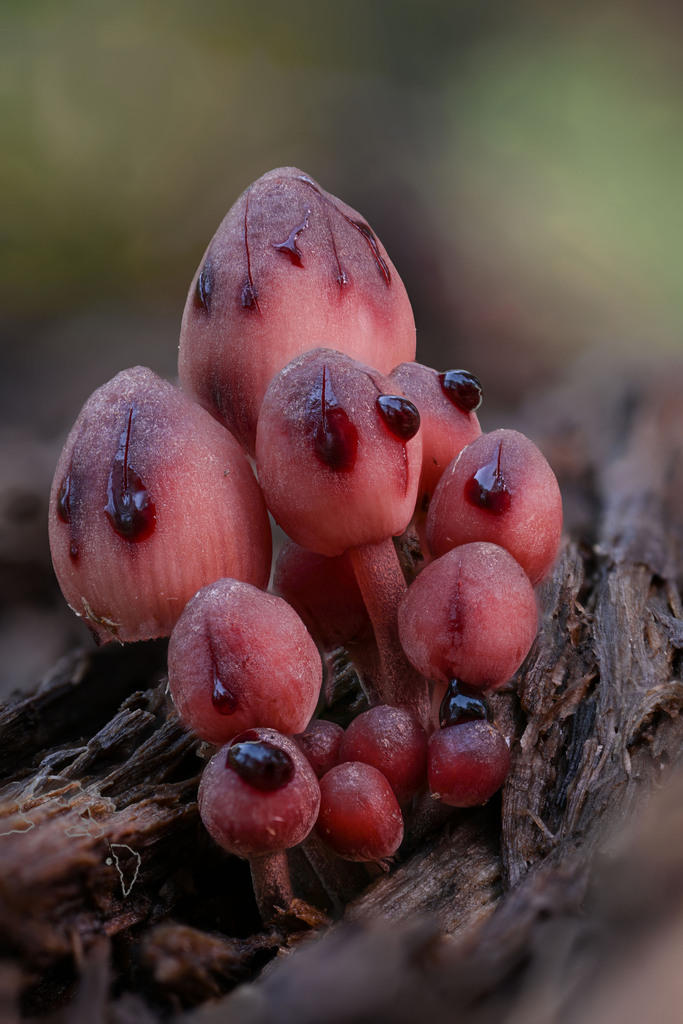
Bleeding Fairy Helmet
Mycena haematopus
Fungusstrong against amphibians, reptiles
Common
Mycelium
While active with another fungus in play, it regains 5 HP at the start of your turn (8 with two others).
40

27
Bleeding Fairy Helmet
Mycena haematopus
Fungusstrong against amphibians, reptiles
Common
While active with another fungus in play, it regains 5 HP at the start of your turn (8 with two others).
Mycena haematopus
Photo: © Alan Rockefeller (original photo) · CC BY 4.0 (licence text) · cropped
Strong against: it deals 20% more damage to them. Weak against: these types deal 20% more damage to it.
Mycena haematopus, commonly known as the bleeding fairy helmet, the burgundydrop bonnet, or the bleeding Mycena, is a species of fungus in the family Mycenaceae, of the order Agaricales. First described scientifically in 1799, it is classified in the section Lactipedes of the genus Mycena, along with other species that produce a milky or colored latex.
The fruit bodies of M. haematopus have caps that are up to 4 cm (1+5⁄8 in) wide, whitish gills, and a thin, fragile reddish-brown stem with thick coarse hairs at the base. They are characterized by their reddish color, the scalloped cap edges, and the dark red latex they "bleed" when cut or broken. Both the fruit bodies and the mycelia are strongly bioluminescent.
It is widespread and common in Europe and North America, and has also been collected in old Japan and Venezuela. It is saprotrophic—meaning that it obtains nutrients by consuming decomposing organic matter—and the fruit bodies appear in small groups or clusters on the decaying logs, trunks, and stumps of deciduous trees, particularly beech. The edibility of the species is not known definitively. It produces various unique alkaloid pigments.
Excerpt from the Wikipedia article Mycena haematopus, by its authors, under the CC BY-SA 4.0 licence.
No global status on the IUCN Red List: that’s what makes this card Common.
Every Common card has 100 points, shared between HP, ATK and DEF:
How they’re shared out:

 DEF 27