 …
Chalk Burnet
Zygaena fausta
Insectstrong against fungi, fish
Common
Swarm
While active with another insect in play, each of its attacks also hits the opposing bench for 10, without knocking them out (20 with two others).
41

39
Chalk Burnet
Zygaena fausta
Insectstrong against fungi, fish
Common
While active with another insect in play, each of its attacks also hits the opposing bench for 10, without knocking them out (20 with two others).
Zygaena fausta
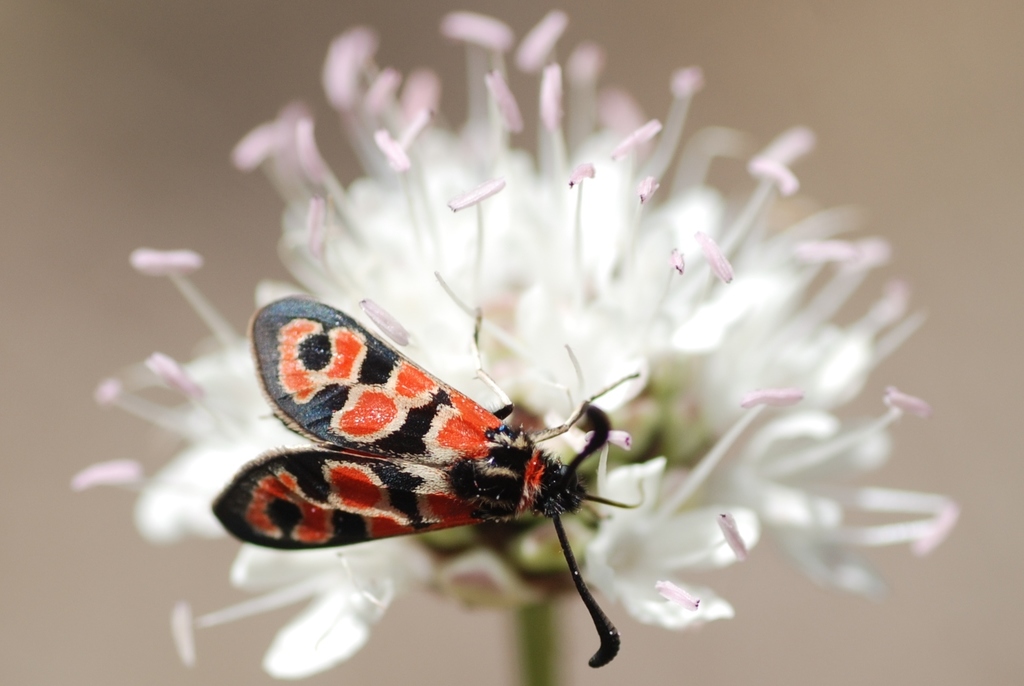
Photo: © Qgroom (original photo) · CC BY 4.0 (licence text) · cropped
Strong against: it deals 20% more damage to them. Weak against: these types deal 20% more damage to it.
Zygaena fausta is a member of the family Zygaenidae, the day-flying burnet moths. Its bright aposematic colours of red, white and black on the wings indicate to possible predators such as birds that it is foul tasting or poisonous. In flight, the bright red abdomen is revealed, contrasting with the white legs and black head and antennae; the thorax is black and white with an eye spot on each side (see image). There appears to be a considerable variation in pattern among specimens from different parts of Europe.
The southwest of Europe is home to Zygaena fausta. The moth can be found from Spain and Southern Portugal to Western Austria and Southern Germany, northeast to Thuringia, and southeast to North-western Italy.
It is rare or absent from Britain, the Netherlands and Belgium, where related species include the similarly aposematic five-spot burnet and the six-spot burnet.
The caterpillar (larva) is dark grey with a black line above a line of white interrupted by yellow bands. The caterpillar's food plants are vetches of the genus Coronilla.
The adults often visit a wide range of flowers including knapweed and eryngo. Typical habitat is dry chalk grassland. Adults fly throughout the summer from April or May until October. The sexes are similar but not identical (see image); mating takes place by day on isolated plants.
Excerpt from the Wikipedia article Zygaena fausta, by its authors, under the CC BY-SA 4.0 licence.
No global status on the IUCN Red List: that’s what makes this card Common.
Every Common card has 100 points, shared between HP, ATK and DEF:
How they’re shared out:

 DEF 39