 …
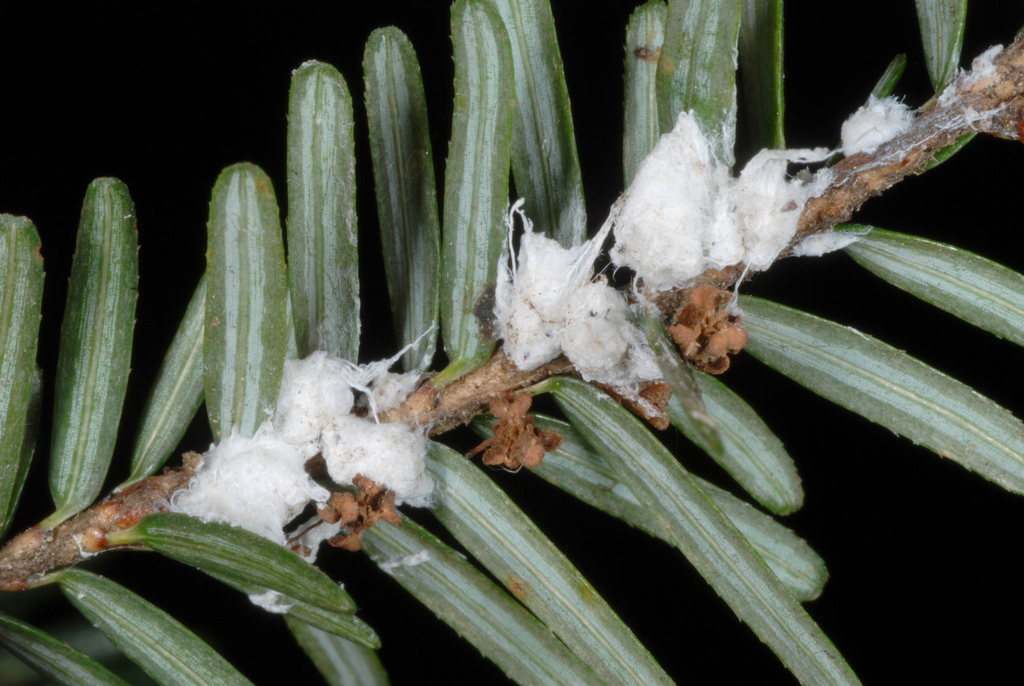
Hemlock Woolly Adelgid
Adelges tsugae
Insectstrong against fungi, fish
Common
Swarm
While active with another insect in play, each of its attacks also hits the opposing bench for 10, without knocking them out (20 with two others).
39

39
Hemlock Woolly Adelgid
Adelges tsugae
Insectstrong against fungi, fish
Common
While active with another insect in play, each of its attacks also hits the opposing bench for 10, without knocking them out (20 with two others).
Adelges tsugae
Photo: © Douglas Goldman (original photo) · CC BY-SA 4.0 (licence text) · cropped
Strong against: it deals 20% more damage to them. Weak against: these types deal 20% more damage to it.
Adelges tsugae, the hemlock woolly adelgid or HWA, is an insect of the order Hemiptera (true bugs) native to East Asia. It feeds by sucking sap from hemlock and spruce trees (Tsuga spp.; Picea spp.). In its native range, HWA is not a serious pest because populations are managed by natural predators and parasitoids and by host resistance. In eastern North America it is a destructive pest that threatens the eastern hemlock (Tsuga canadensis) and the Carolina hemlock (Tsuga caroliniana). HWA is also found in western North America, where it has likely been present for thousands of years. In western North America, it primarily attacks western hemlock (Tsuga heterophylla) and has only caused minor damage due to natural predators and host resistance. Accidentally introduced to North America from Japan, HWA was first found in the eastern United States near Richmond, Virginia, in 1951. The pest is now found from northern Georgia to coastal Maine and southwestern Nova Scotia as well as areas of western Michigan near the eastern Lake Michigan shoreline. As of 2015, HWA has affected 90% of the geographic range of eastern hemlock in North America.
Excerpt from the Wikipedia article Hemlock woolly adelgid, by its authors, under the CC BY-SA 4.0 licence.
No global status on the IUCN Red List: that’s what makes this card Common.
Every Common card has 100 points, shared between HP, ATK and DEF:
How they’re shared out:

 DEF 39