
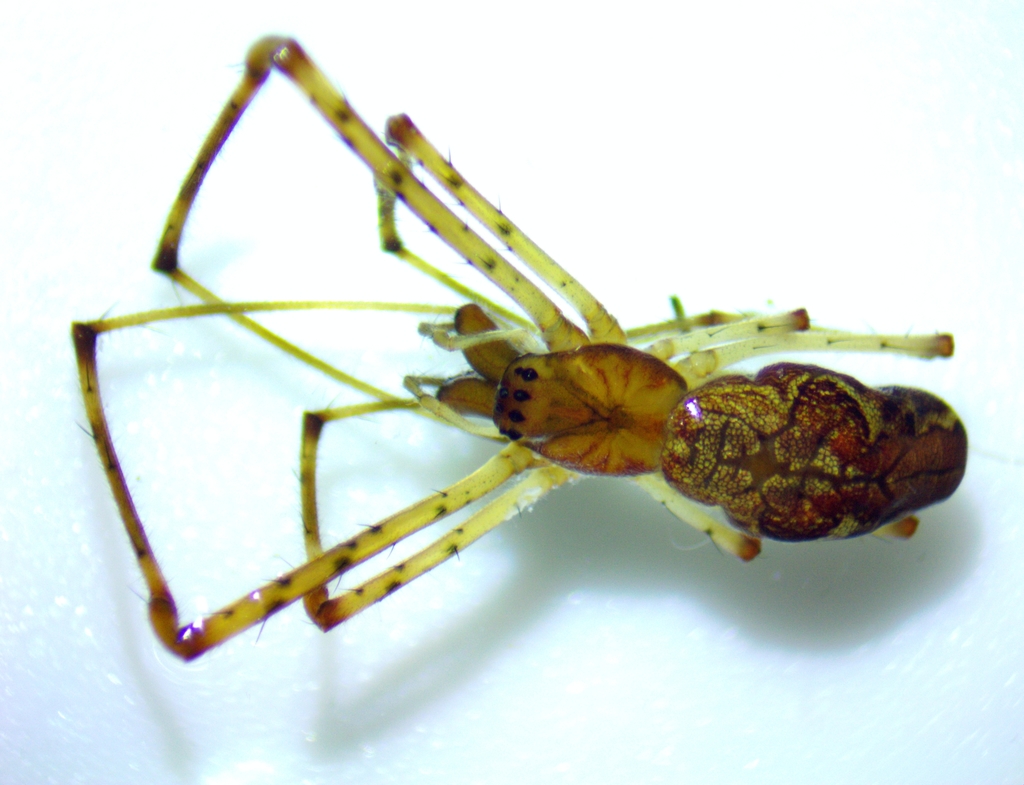
Versicolor Long-jawed Orbweaver
Tetragnatha versicolor
Arachnidstrong against insects, birds
Common
While active with another arachnid in play, its target loses 4 HP at the start of each of its turns, as long as it stays active (7 with two others).

Versicolor Long-jawed Orbweaver
Tetragnatha versicolor
Arachnidstrong against insects, birds
Common
While active with another arachnid in play, its target loses 4 HP at the start of each of its turns, as long as it stays active (7 with two others).
Tetragnatha versicolor
Photo: © Chris LaRosee (original photo) · CC BY 4.0 (licence text) · cropped
Strong against: it deals 20% more damage to them. Weak against: these types deal 20% more damage to it.
Tetragnatha versicolor is a species of long-jawed orb weaver in the spider family Tetragnathidae. It is found throughout North America, Canada, Central America, and Cuba, but are most common in the United States. T. versicolor is heavily concentrated in New England and the west coast in states like California and Washington. T. versicolor is considered a habitat generalist, and can thrive in many different environments. While they can be found in places like Grasslands, Wetlands, Forests, etc., they prefer dryer areas like normal trees and shrubs. Unlike other spiders in the genus Tetragnatha, T. versicolor will rarely reside near aquatic environments. T. versicolor will typically be colored dark yellow or pale orange and average around 5 mm for males and 6.5 mm for females in length, which is very small for a spider. They are much longer than they are wide, making them very distinct. In addition, T. versicolor can be distinguished from other spiders in Tetragnatha by the distinct separation of the anterior/posterior eyes and the appearance of their reproductive organs. As an orb weaver spider, T. versicolor creates a web to hunt for prey. It will wait at night for prey to stumble into its web and use vibrational signals throughout the web to sense trapped prey. In terms of mating behavior, T. versicolor lacks a distinct courting ritual and will mate with any others in the proximity. Mating behavior is heavily affected by female mating history.
Abridged excerpt from the Wikipedia article Tetragnatha versicolor, by its authors, under the CC BY-SA 4.0 licence.
No global status on the IUCN Red List: that’s what makes this card Common.
Every Common card has 100 points, shared between HP, ATK and DEF:
How they’re shared out:

