
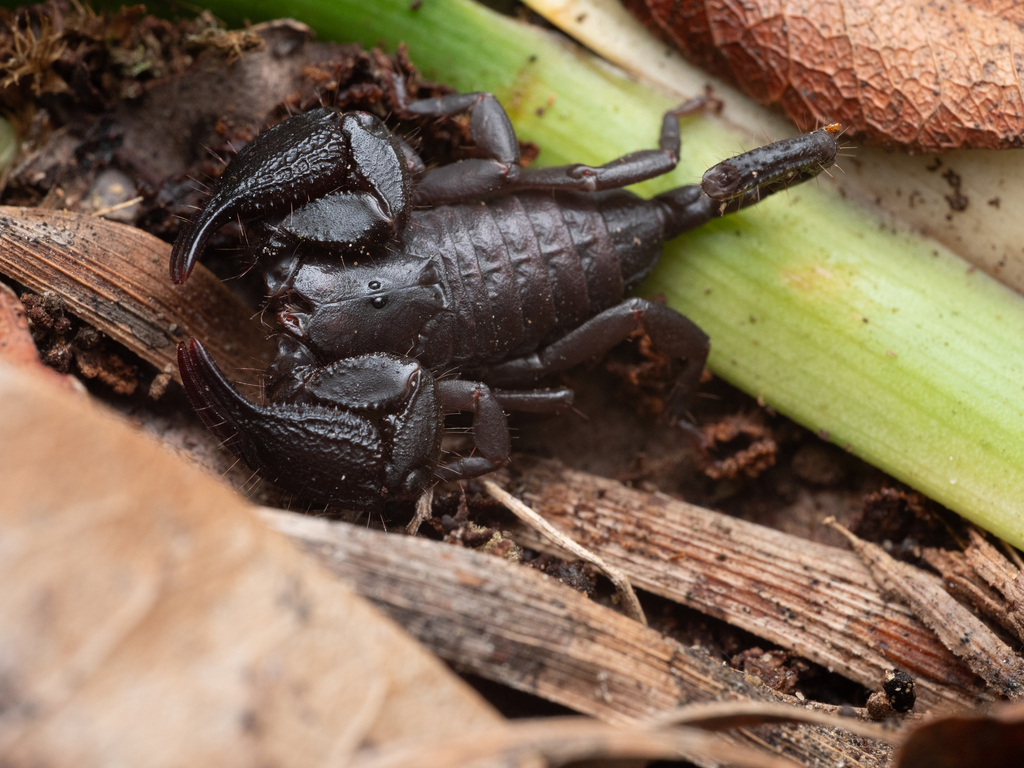
Cape Docile Scorpion
Opisthacanthus capensis
Arachnidstrong against insects, birds
Common
While active with another arachnid in play, its target loses 4 HP at the start of each of its turns, as long as it stays active (7 with two others).

Cape Docile Scorpion
Opisthacanthus capensis
Arachnidstrong against insects, birds
Common
While active with another arachnid in play, its target loses 4 HP at the start of each of its turns, as long as it stays active (7 with two others).
Opisthacanthus capensis
Photo: iNaturalist (original photo) · CC0 (licence text) · cropped
Strong against: it deals 20% more damage to them. Weak against: these types deal 20% more damage to it.
Opisthacanthus capensis is a Cape Province and Zimbabwean species of scorpion with robust chelae, dark brown to black in colour, turning green when under cover for some time. Opisthacanthus scorpions are arboreal and ground-dwelling, and found mainly in moist habitats in dense vegetation, pine plantations and forests, and hiding under bark and rocks.
Its venom contains powerful neurotoxins and cytotoxins, including mucopolysaccharides, hyaluronidases, phospholipases, serotonins, histamines, enzyme inhibitors, and proteins such as neurotoxic peptides. The venom from O. capensis is largely composed of melittin which stimulates the release of the enzyme phospholipase A2 causing inflammation and pain. Phospholipase A2 cleaves the SN-2 acyl chain, releasing arachidonic acid. However, in humans, it's only mildly venomous, with his sting only causing local pain.
This species features in the diets of the bat-eared fox Otocyon megalotis (Canidae), the yellow mongoose Cynictis penicillata, the small grey mongoose Galerella pulverulenta, and the water mongoose Atilax paludinosus (Viverridae).
Excerpt from the Wikipedia article Opisthacanthus capensis, by its authors, under the CC BY-SA 4.0 licence.
No global status on the IUCN Red List: that’s what makes this card Common.
Every Common card has 100 points, shared between HP, ATK and DEF:
How they’re shared out:

