 …
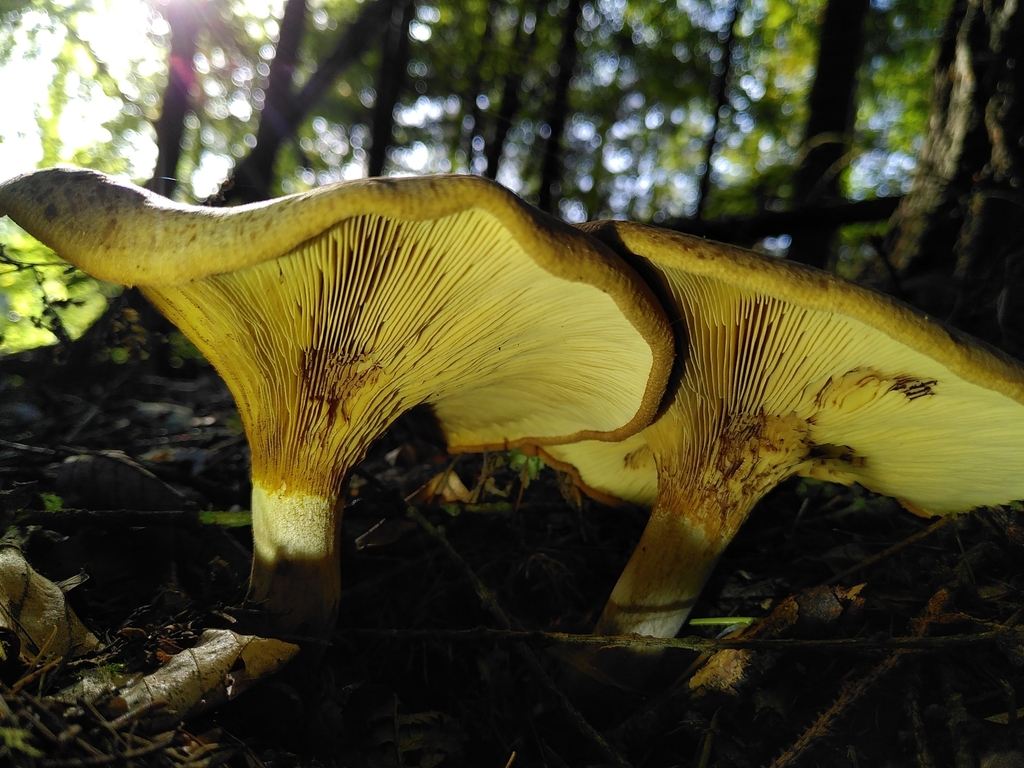
Brown Roll-Rim
Paxillus involutus
Fungusstrong against amphibians, reptiles
Common
Mycelium
While active with another fungus in play, it regains 5 HP at the start of your turn (8 with two others).
40

28
Brown Roll-Rim
Paxillus involutus
Fungusstrong against amphibians, reptiles
Common
While active with another fungus in play, it regains 5 HP at the start of your turn (8 with two others).
Paxillus involutus
Photo: © Lorenz Wenner (original photo) · CC BY 4.0 (licence text) · cropped
Strong against: it deals 20% more damage to them. Weak against: these types deal 20% more damage to it.
Paxillus involutus, also known as the brown roll-rim or the common roll-rim, is a species of basidiomycete fungus. Although it has gills, it is more closely related to the pored boletes than to typical gilled mushrooms. It was first described by Pierre Bulliard in 1785, and was given its current binomial name by Elias Magnus Fries in 1838. Genetic testing suggests that Paxillus involutus may be a species complex rather than a single species. Various shades of brown in colour, the fruit body grows up to 6 cm (2+3⁄8 in) high and has a funnel-shaped cap up to 12 cm (4+3⁄4 in) wide with a distinctive inrolled rim and decurrent gills that may be pore-like close to the stipe.
The species is widely distributed across the Northern Hemisphere. It has been inadvertently introduced to Australia, New Zealand, South Africa, and South America, probably transported in soil with European trees. It is common in deciduous and coniferous woods and grass in late summer and autumn, forming ectomycorrhizal relationships with a broad range of tree species. These benefit from the symbiosis as the fungus reduces their intake of heavy metals and increases resistance to pathogens such as Fusarium oxysporum.
Abridged excerpt from the Wikipedia article Paxillus involutus, by its authors, under the CC BY-SA 4.0 licence.
No global status on the IUCN Red List: that’s what makes this card Common.
Every Common card has 100 points, shared between HP, ATK and DEF:
How they’re shared out:

 DEF 28