 …
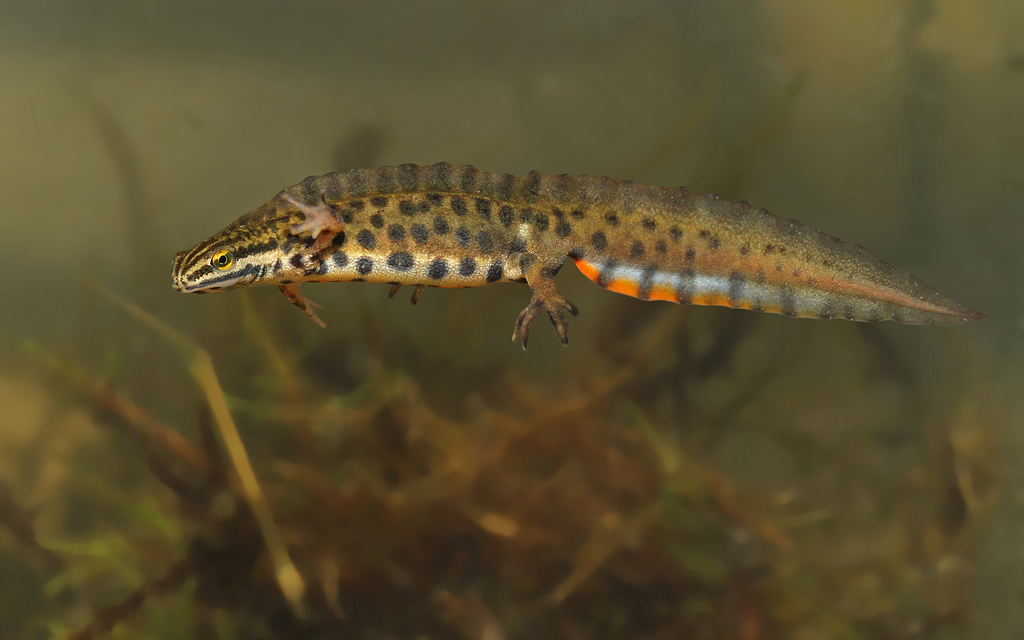
Smooth Newt
Lissotriton vulgaris
Amphibianstrong against insects, arachnids
Common
Toxic skin
While active with another amphibian in play, any card that hits it loses 6 HP, without being knocked out (12 with two others).
36

38
Smooth Newt
Lissotriton vulgaris
Amphibianstrong against insects, arachnids
Common
While active with another amphibian in play, any card that hits it loses 6 HP, without being knocked out (12 with two others).
Lissotriton vulgaris
Photo: © Christoph Moning (original photo) · CC BY 4.0 (licence text) · cropped
Strong against: it deals 20% more damage to them. Weak against: these types deal 20% more damage to it.
The smooth newt, European newt, northern smooth newt or common newt (Lissotriton vulgaris) is a species of newt. It is widespread in Europe and parts of Asia, and has also been introduced to Australia. Individuals are brown with a spotted underside that ranges in colour from orange to white. They reach an average length of 8–11 cm (3.1–4.3 in), with males being larger than females. The newts' skins are dry and velvety when they are living on land, but become smooth when they migrate into the water to breed. Males develop a more vivid colour pattern and a conspicuous skin seam (crest) on their back during the breeding season.
The smooth newt was originally described by Carl Linnaeus as a lizard, and was then given different genus names before being classified as a member of Lissotriton. There are currently three accepted subspecies of smooth newt. Formerly, there were also four subspecies—all with more restricted ranges that are now classified as separate species, because they have been found to be distinct genetically as well as in appearance: the Caucasian smooth newt, the Greek smooth newt, Kosswig's smooth newt and Schmidtler's smooth newt. Together with these four species and the Carpathian newt, the smooth newt forms what is known as a species complex: some of the species hybridise with each other.
Abridged excerpt from the Wikipedia article Smooth newt, by its authors, under the CC BY-SA 4.0 licence.
Least Concern on the IUCN Red List: that’s what makes this card Common.
Every Common card has 100 points, shared between HP, ATK and DEF:
How they’re shared out:

 DEF 38