 …
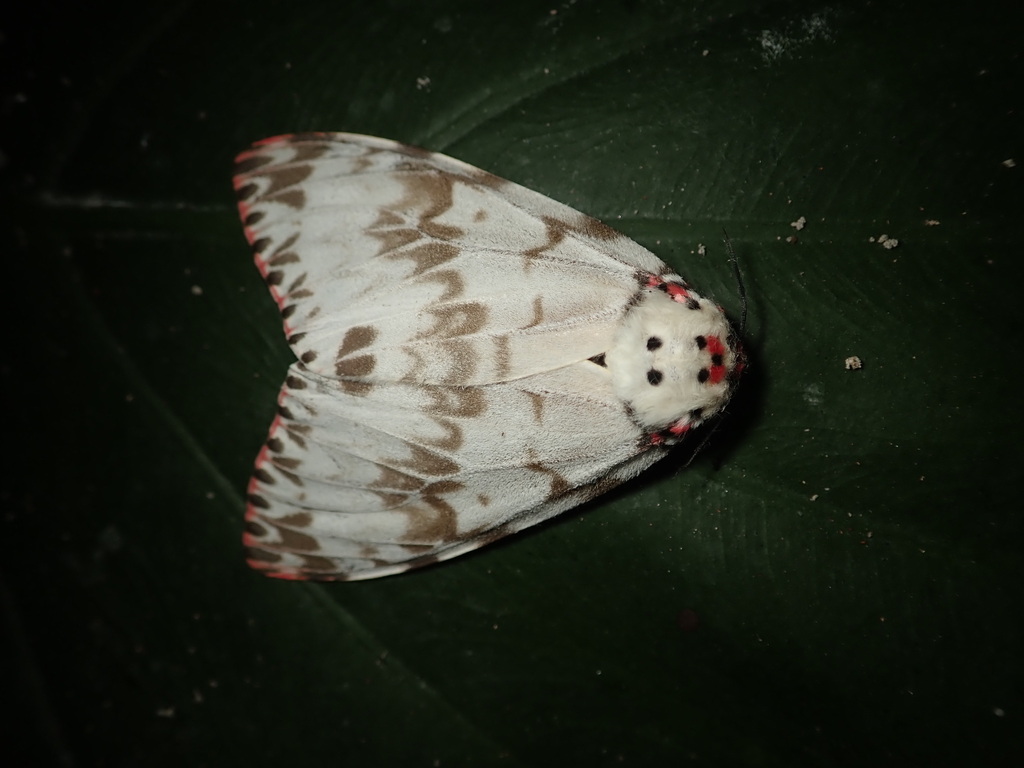
Pink Lymantria Moth
Lymantria mathura
Insectstrong against fungi, fish
Common
Swarm
While active with another insect in play, each of its attacks also hits the opposing bench for 10, without knocking them out (20 with two others).
39

38
Pink Lymantria Moth
Lymantria mathura
Insectstrong against fungi, fish
Common
While active with another insect in play, each of its attacks also hits the opposing bench for 10, without knocking them out (20 with two others).
Lymantria mathura
Photo: © Chung-Yen (original photo) · CC BY 4.0 (licence text) · cropped
Strong against: it deals 20% more damage to them. Weak against: these types deal 20% more damage to it.
Lymantria mathura, the rosy gypsy moth, is a species of moth of the family Erebidae found in the Russian Far East, Nepal, Japan (Hokkaido, Honshu, Kyushu), the Korean Peninsula, northern India and China (at least Hebei, Heilongjiang, Jilin also in the west). The species was first described by Frederic Moore in 1866.
The wingspan is 40–50mm for males and 70–90mm for females. Larvae disperse through ballooning, covering greater distances compared to the Lymantria dispar and exhibiting high rates of settling. Larvae have also been recorded feeding on Terminalia, Shorea, Quercus, Mangifera, Eugenia and Mitragyna. It is considered a pest, since it is a major defoliator of deciduous trees. Their larvae exhibit intraspecific variation to polyphenol metabolism depending on their host plant, allowing them to be polyphagous across multiple broadleaf species.
Excerpt from the Wikipedia article Lymantria mathura, by its authors, under the CC BY-SA 4.0 licence.
No global status on the IUCN Red List: that’s what makes this card Common.
Every Common card has 100 points, shared between HP, ATK and DEF:
How they’re shared out:

 DEF 38