 …
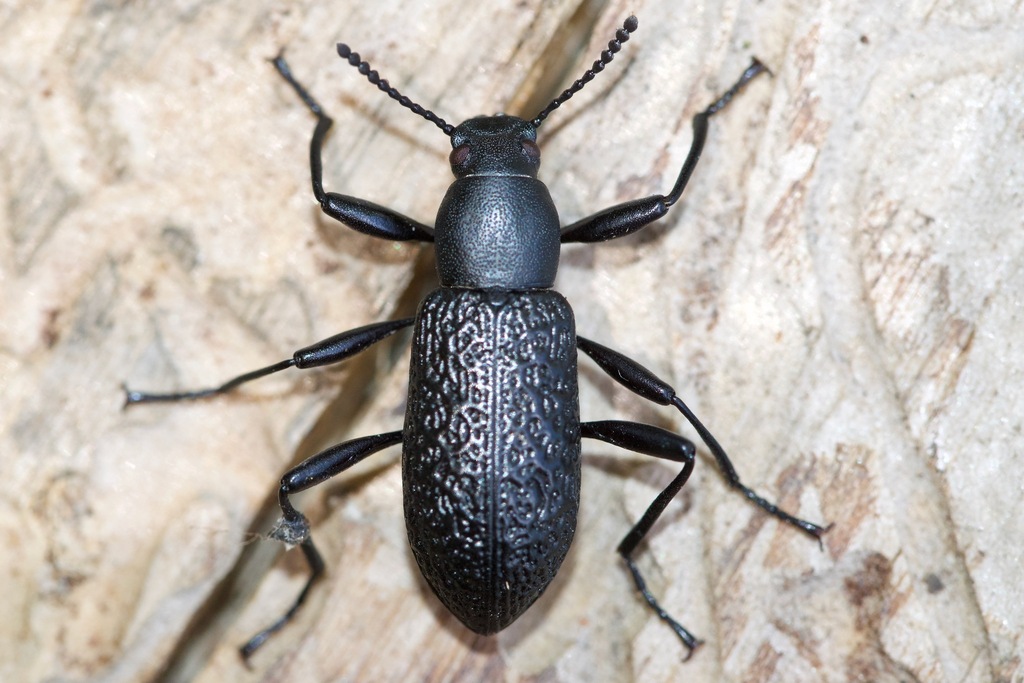
Roughened Darkling Beetle
Upis ceramboides
Insectstrong against fungi, fish
Common
Swarm
While active with another insect in play, each of its attacks also hits the opposing bench for 10, without knocking them out (20 with two others).
39

38
Roughened Darkling Beetle
Upis ceramboides
Insectstrong against fungi, fish
Common
While active with another insect in play, each of its attacks also hits the opposing bench for 10, without knocking them out (20 with two others).
Upis ceramboides
Photo: © Owen Strickland (original photo) · CC BY 4.0 (licence text) · cropped
Strong against: it deals 20% more damage to them. Weak against: these types deal 20% more damage to it.
Upis ceramboides is a species of beetle, one of many wood-living insects that benefit from forest fires. It often occurs in quantities below the bark on the fire-damaged birches, but can sometimes be seen on other deciduous trees such as willow and aspen. The larvae thrive in the inner bark which is rich in mycelia, and in the sapwood. They develop into pupae during the summer months under the bark, and they develop over two or three years. The following spring they reproduce themselves.
It has over the years have disappeared from southern Sweden and is now only locally in the Norrland coast (Västerbotten and Norrbotten) as well as Canada and Alaska. The reason for the species' decline is probably the lack of fire-damaged forests and birch, and the modern forestry practices. Upis ceramboides is considered "vulnerable" in terms of species survival. In Vindeln municipality it is called köksskörven, because it occurs indoors when burning firewood in winter.
The species' survival at temperatures well below freezing are attributed to the xylomannan non-protein antifreeze molecule (polysaccharide and a fatty acid) as well as the sugar-alcohol, threitol.
Other notable freeze-tolerant animals include the fly Polypedilum vanderplanki and the beetle Cucujus clavipes puniceus.
Excerpt from the Wikipedia article Upis ceramboides, by its authors, under the CC BY-SA 4.0 licence.
No global status on the IUCN Red List: that’s what makes this card Common.
Every Common card has 100 points, shared between HP, ATK and DEF:
How they’re shared out:

 DEF 38