 …
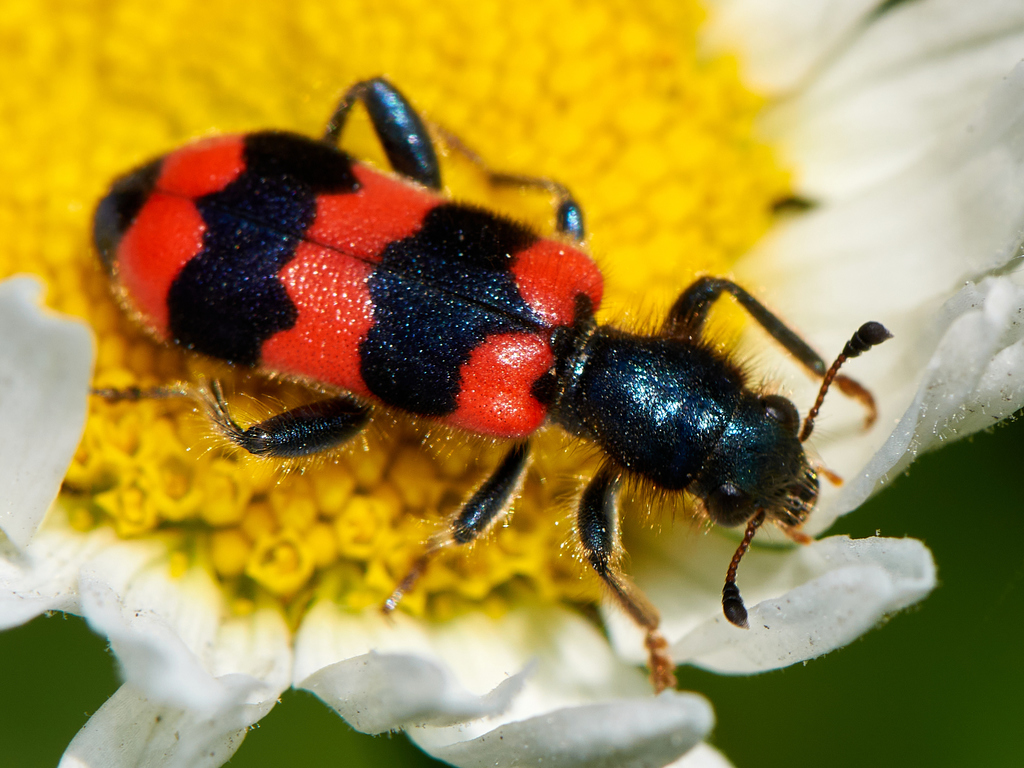
Bee-eating Beetle
Trichodes apiarius
Insectstrong against fungi, fish
Common
Swarm
While active with another insect in play, each of its attacks also hits the opposing bench for 10, without knocking them out (20 with two others).
39

39
Bee-eating Beetle
Trichodes apiarius
Insectstrong against fungi, fish
Common
While active with another insect in play, each of its attacks also hits the opposing bench for 10, without knocking them out (20 with two others).
Trichodes apiarius
Photo: © Сергей Неклюдов (original photo) · CC BY 4.0 (licence text) · cropped
Strong against: it deals 20% more damage to them. Weak against: these types deal 20% more damage to it.
Trichodes apiarius is a beetle species of checkered beetles belonging to the family Cleridae, subfamily Clerinae. It is found in most of Europe, in the eastern Palearctic realm, and in North Africa.
The adult is a hairy, small beetle with shining blue or black head and scutellum. The elongated elytra (wing cases) are bright red with black bands. This species can easily be distinguished from Trichodes alvearius for the black terminal band reaching the apex of the elytra. Adults grow up to 9–16 millimetres (0.35–0.63 in) and can be encountered from May through June on the flowers, mainly Apiaceae, feeding on the pollen. They also actively hunt small insects.
The larvae are parasites of bees (hence the name “apiarius”), as the adults lay the eggs in the nests of solitary bees (Osmia and Megachile species) or in hives of honey bees, eating larvae and nymphs.
Excerpt from the Wikipedia article Trichodes apiarius, by its authors, under the CC BY-SA 4.0 licence.
No global status on the IUCN Red List: that’s what makes this card Common.
Every Common card has 100 points, shared between HP, ATK and DEF:
How they’re shared out:

 DEF 39