 …
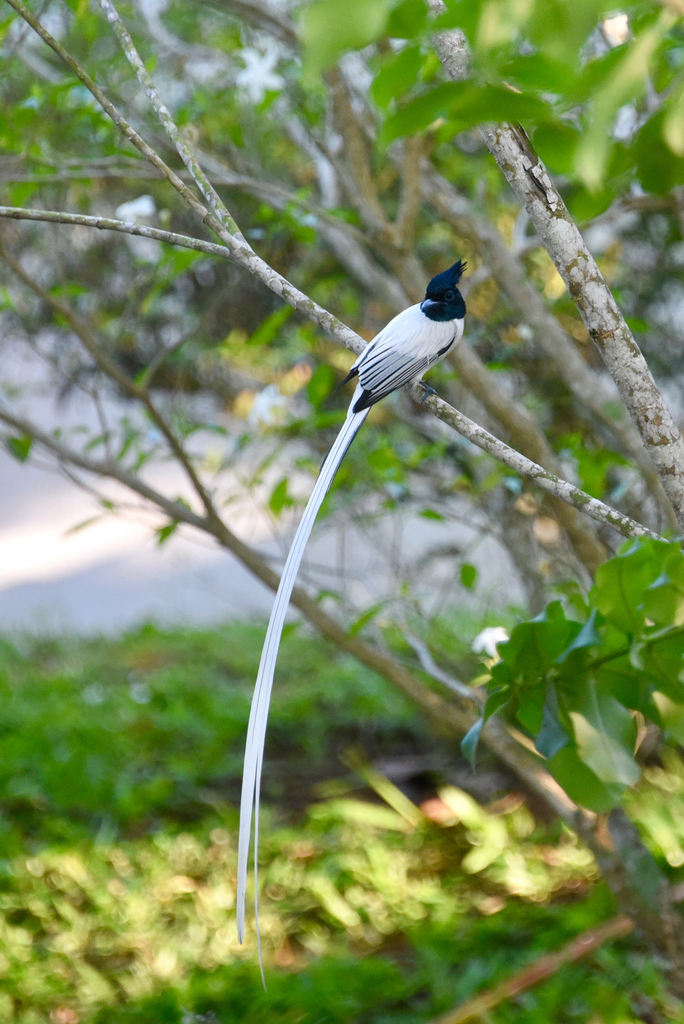
Indian Paradise-Flycatcher
Terpsiphone paradisi
Birdstrong against fish, reptiles
Common
Swoop
While active with another bird in play, it hits 6 harder on its first attack after entering play (12 with two others).
31

39
Indian Paradise-Flycatcher
Terpsiphone paradisi
Birdstrong against fish, reptiles
Common
While active with another bird in play, it hits 6 harder on its first attack after entering play (12 with two others).
Terpsiphone paradisi
Photo: © melianie_max_and_asker (original photo) · CC BY 4.0 (licence text) · cropped
Strong against: it deals 20% more damage to them. Weak against: these types deal 20% more damage to it.
The Indian paradise flycatcher (Terpsiphone paradisi) is a medium-sized passerine bird in the monarch flycatcher family, Monarchidae. As the global population is considered stable, it has been listed as Least Concern on the IUCN Red List since 2004. It is native to the Indian subcontinent, with resident and breeding populations in most of Bangladesh, India and Sri Lanka, as well as parts of Afghanistan, Bhutan, China, Myanmar, Nepal, Pakistan, Tajikistan and Turkmenistan.
The Indian paradise flycatcher has a length of 20–50 cm (7.9–19.7 in) from beak to tail. Males have elongated central tail feathers, and a black and rufous plumage in some populations, while others have white plumage. Females are short-tailed with rufous wings and a black head. Indian paradise flycatchers feed on insects, including grasshoppers, butterflies and praying mantises, as well as flies. The Indian paradise flycatcher typically captures prey in the air, kills it by hitting it on a rock, and then extracts the inner parts. often below a densely canopied tree.
Excerpt from the Wikipedia article Indian paradise flycatcher, by its authors, under the CC BY-SA 4.0 licence.
Least Concern on the IUCN Red List: that’s what makes this card Common.
Every Common card has 100 points, shared between HP, ATK and DEF:
How they’re shared out:

 DEF 39