
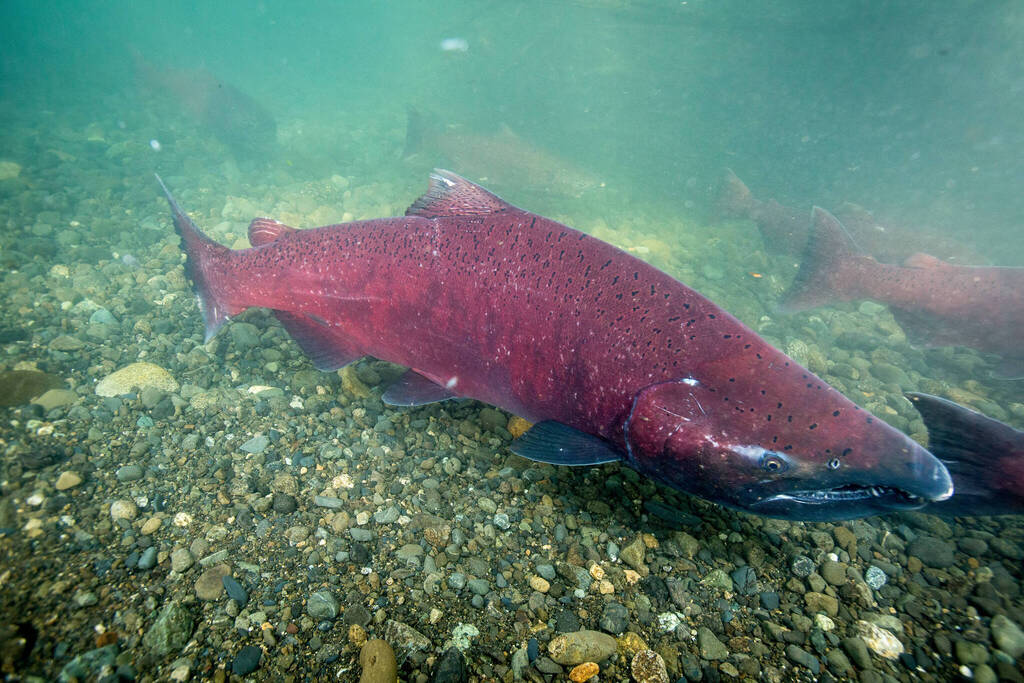
Chinook Salmon
Oncorhynchus tshawytscha
Fishstrong against mammals, arachnids
Common
While active with another fish in play, a fish on your bench absorbs up to 9 of the damage this card takes, without being knocked out (18 with two others).

Chinook Salmon
Oncorhynchus tshawytscha
Fishstrong against mammals, arachnids
Common
While active with another fish in play, a fish on your bench absorbs up to 9 of the damage this card takes, without being knocked out (18 with two others).
Oncorhynchus tshawytscha
Photo: United States Fish and Wildlife Services (original photo) · public domain (licence text) · cropped
Strong against: it deals 20% more damage to them. Weak against: these types deal 20% more damage to it.
The Chinook salmon (Oncorhynchus tshawytscha) is the largest and most valuable species of Pacific salmon. Its common name is derived from the Chinookan peoples. Other vernacular names for the species include king salmon, quinnat salmon, tsumen, spring salmon, blackmouth, and tyee salmon. The scientific species name is based on the Russian common name chavycha (чавыча).
Chinook are anadromous fish native to the North Pacific Ocean and the river systems of western North America, ranging from California to Alaska, as well as Asian rivers ranging from northern Japan to the Palyavaam River in Arctic northeast Siberia. They have been introduced to other parts of the world, including New Zealand and Patagonia. Introduced Chinook salmon are thriving in Lake Michigan and Michigan's western rivers. A large Chinook is a prized and sought-after catch for a sporting angler. The flesh of the salmon is also highly valued for its nutritional content, which includes high levels of important omega-3 fatty acids. Some populations are endangered; however, many are healthy. The Chinook salmon has not been assessed for the IUCN Red List. According to NOAA, the Chinook salmon population along the California coast is declining from factors such as overfishing, loss of freshwater and estuarine habitat, hydropower development, poor ocean conditions, and hatchery practices.
Excerpt from the Wikipedia article Chinook salmon, by its authors, under the CC BY-SA 4.0 licence.
Least Concern on the IUCN Red List: that’s what makes this card Common.
Every Common card has 100 points, shared between HP, ATK and DEF:
How they’re shared out:

