 …
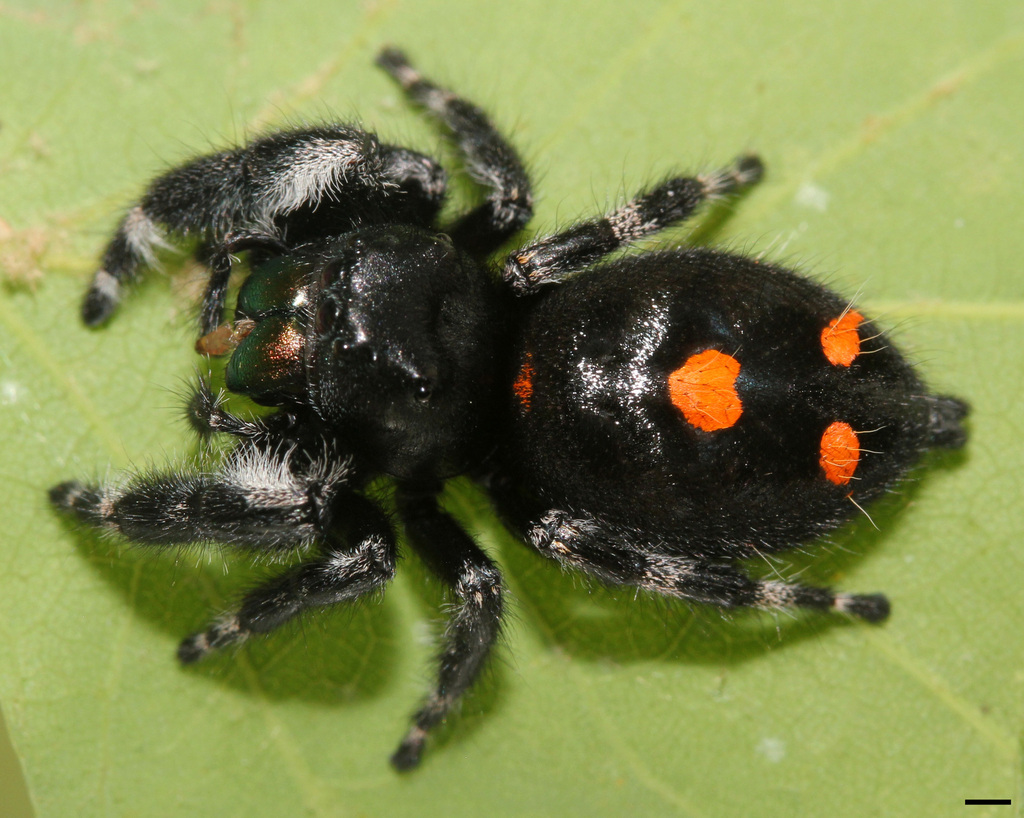
Bold Jumping Spider
Phidippus audax
Arachnidstrong against insects, birds
Common
Venom
While active with another arachnid in play, its target loses 4 HP at the start of each of its turns, as long as it stays active (7 with two others).
42

26
Bold Jumping Spider
Phidippus audax
Arachnidstrong against insects, birds
Common
While active with another arachnid in play, its target loses 4 HP at the start of each of its turns, as long as it stays active (7 with two others).
Phidippus audax
Photo: © David Hill (original photo) · CC BY 4.0 (licence text) · cropped
Strong against: it deals 20% more damage to them. Weak against: these types deal 20% more damage to it.
Phidippus audax, the bold jumper or daring jumping spider, is a common species of spider belonging to the genus Phidippus, a group of jumping spiders easily identified by their large eyes and iridescent chelicerae. The bold jumper itself bears white abdominal dorsal spots, one of them prominent. Like all jumping spiders, they have excellent stereoscopic vision that aids them in stalking prey and facilitates visual communication with potential mates during courting. Bold jumping spiders are native to North America and have been introduced to Hawaii, Nicobar Islands, Azores, and the Netherlands.
Bold jumping spiders are solitary carnivores that use their highly specialized eyesight to actively hunt and stalk prey. They prey on a variety of insects and non-insect terrestrial arthropods such as caterpillars, dragonflies, grasshoppers, and other spiders. They are one of the most common spiders found in agricultural areas and have been studied to determine their impact on crop pest populations. Unlike most spiders, bold jumpers do not build webs to catch prey.
These spiders can be found in temperate climates in a variety of terrestrial habitats including grasslands, chaparrals, open woodlands, and agricultural fields. The bold jumper is one of the most commonly occurring spider species within its range and is often found living in close proximity to humans. Bites from Phidippus audax are rare but may occur if they feel threatened or are mishandled.
Excerpt from the Wikipedia article Phidippus audax, by its authors, under the CC BY-SA 4.0 licence.
No global status on the IUCN Red List: that’s what makes this card Common.
Every Common card has 100 points, shared between HP, ATK and DEF:
How they’re shared out:

 DEF 26