 …
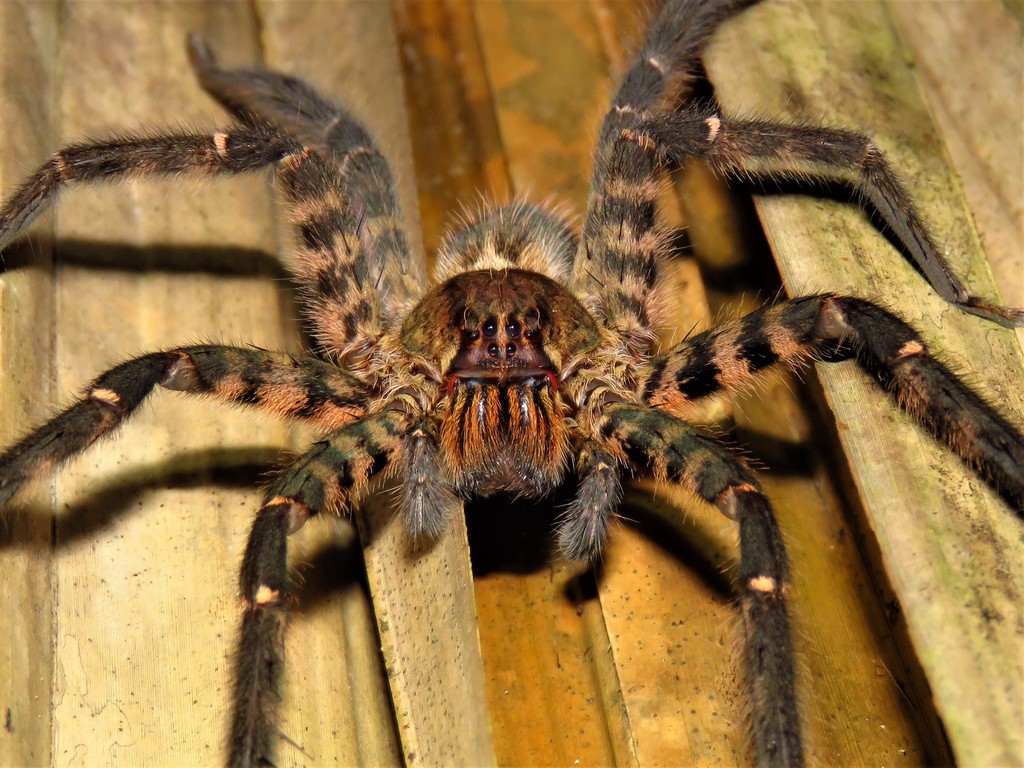
Tiger Bromeliad Spider
Cupiennius salei
Arachnidstrong against insects, birds
Common
Venom
While active with another arachnid in play, its target loses 4 HP at the start of each of its turns, as long as it stays active (7 with two others).
40

27
Tiger Bromeliad Spider
Cupiennius salei
Arachnidstrong against insects, birds
Common
While active with another arachnid in play, its target loses 4 HP at the start of each of its turns, as long as it stays active (7 with two others).
Cupiennius salei
Photo: © Annika Lindqvist (original photo) · CC BY 4.0 (licence text) · cropped
Strong against: it deals 20% more damage to them. Weak against: these types deal 20% more damage to it.
Cupiennius salei, from the genus Cupiennius also commonly called the tiger bromeliad spider, which are large bodied, actively-hunting spiders that are part of the family Trechaleidae.
In the mid-1950s it was realised that the spider is an ideal model for biological research because of their large size, predictable behaviour, and ease of breeding in laboratories. From an initial 1963 publication on its biological characteristics, their venom has also become one of the most studied among spiders, which now known to include complex Neurotoxins, such as cupiennins and CSTX.
As with most spiders which also use venom to subdue prey, the bite of Cupiennius salei is not medically significant for humans, therefore they are not be considered dangerous. In particular, a peptide called CsTx-1 is highly potent for paralysing their prey which is mostly small insects.
They are visually similar to another group called wandering spiders (but also see that diverse kinds often get mistakenly called banana spiders).
Excerpt from the Wikipedia article Cupiennius salei, by its authors, under the CC BY-SA 4.0 licence.
No global status on the IUCN Red List: that’s what makes this card Common.
Every Common card has 100 points, shared between HP, ATK and DEF:
How they’re shared out:

 DEF 27