 …
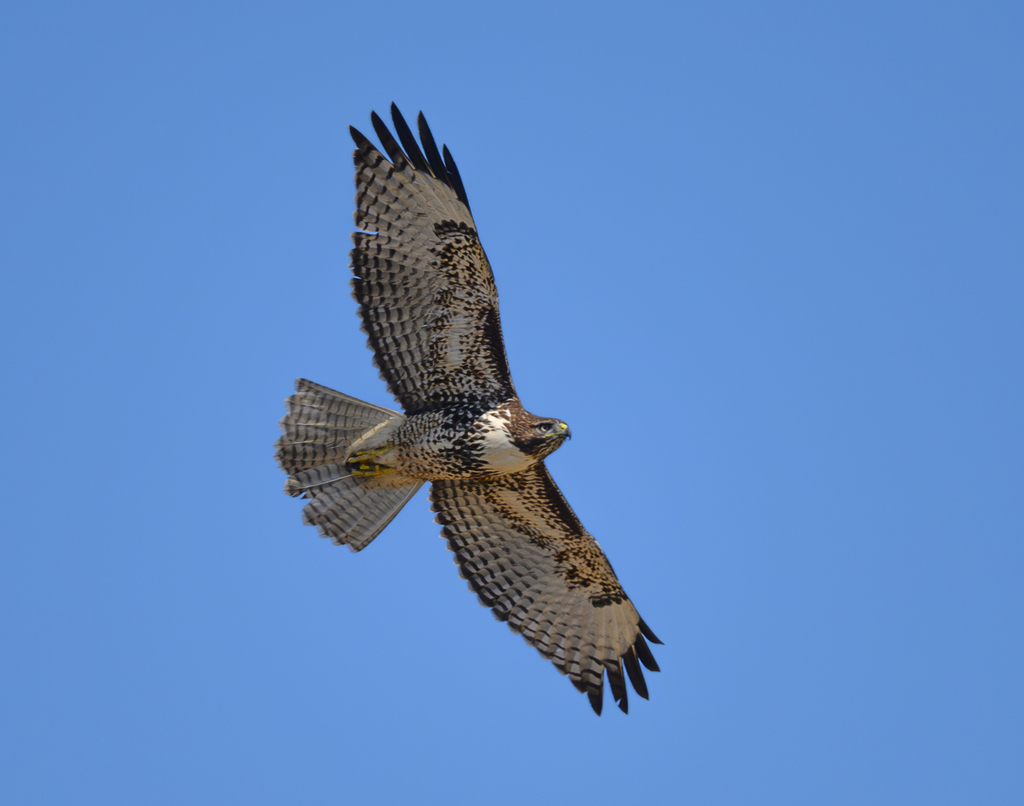
Red-tailed Hawk
Buteo jamaicensis
Birdstrong against fish, reptiles
Common
Swoop
While active with another bird in play, it hits 6 harder on its first attack after entering play (12 with two others).
31

31
Red-tailed Hawk
Buteo jamaicensis
Birdstrong against fish, reptiles
Common
While active with another bird in play, it hits 6 harder on its first attack after entering play (12 with two others).
Buteo jamaicensis
Photo: Claude Lyneis (original photo) · CC0 (licence text) · cropped
Strong against: it deals 20% more damage to them. Weak against: these types deal 20% more damage to it.
The red-tailed hawk (Buteo jamaicensis) is a bird of prey and one of the most common hawks in North America. In the United States, it is one of three species colloquially known as the "chickenhawk". The red-tailed hawk breeds throughout most of the continent, from western Alaska and northern Canada to as far south as Panama and the West Indies. The red-tailed hawk occupies a wide range of habitats and altitudes, including deserts, grasslands, coniferous and deciduous forests, agricultural fields, and urban areas. It is absent in areas of unbroken forest and in the high arctic. It is legally protected in Canada, Mexico, and the United States by the Migratory Bird Treaty.
The red-tailed hawk is one of the largest members of the genus Buteo in North America, typically weighing from 690 to 1,600 g (1.5 to 3.5 lb) and measuring 45–65 cm (18–26 in) in length, with a wingspan from 110–145 cm (43–57 in). Females are about 25% heavier than males. It has a stocky body with broad wings and can be distinguished from other North American hawks by the eponymous tail, which is uniformly brick-red above and light buff-orange below. The species feeds on a wide range of small animals, such as rodents, birds, and reptiles. Pairs stay together for life, taking a new mate only when the original mate dies. The pair constructs a stick nest in a high tree, in which a clutch of one to three eggs is laid.
Abridged excerpt from the Wikipedia article Red-tailed hawk, by its authors, under the CC BY-SA 4.0 licence.
Least Concern on the IUCN Red List: that’s what makes this card Common.
Every Common card has 100 points, shared between HP, ATK and DEF:
How they’re shared out:

 DEF 31