 …
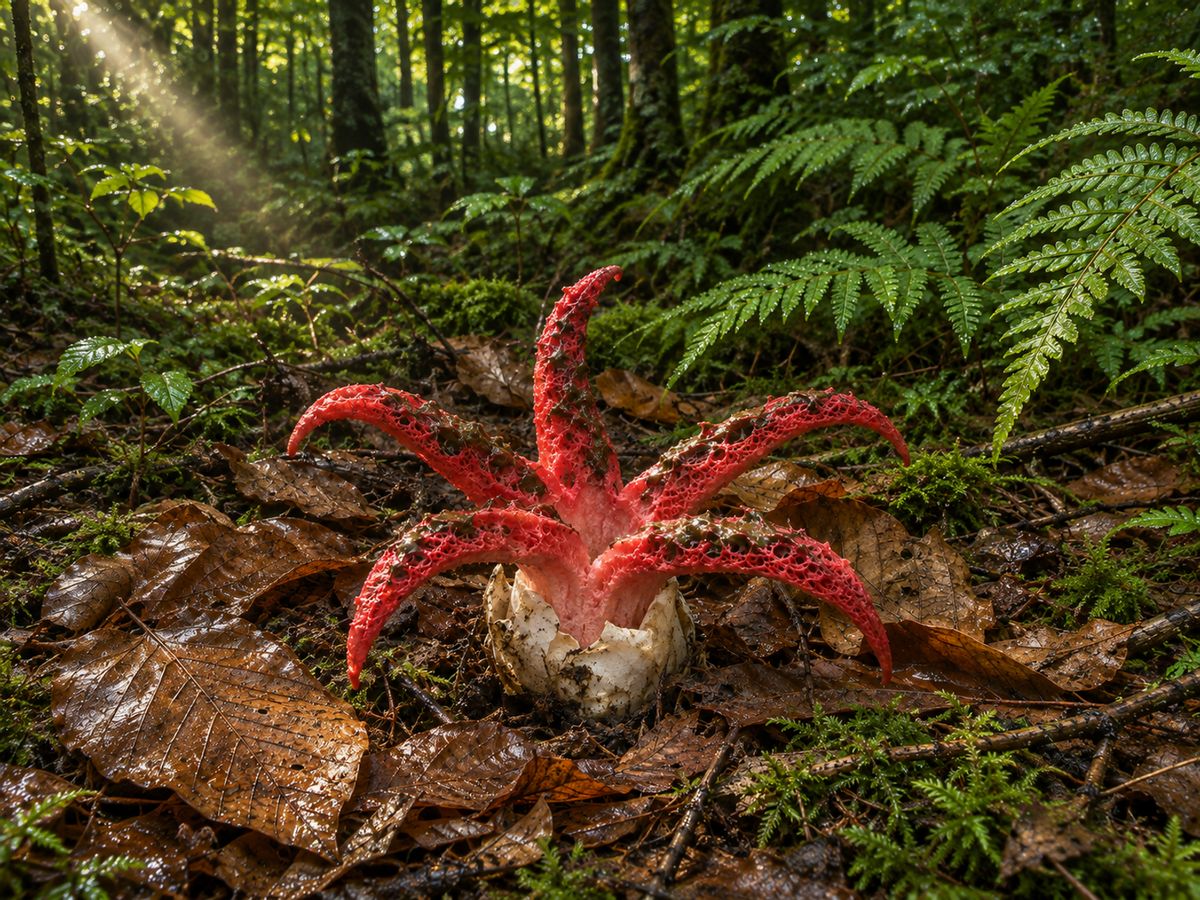

devil's-fingers
Clathrus archeri
Fungusstrong against amphibians, reptiles
Legendary
Carrion stench
At the start of your turn, if it’s active, it deals 10 damage to the opposing active card.
73
50
devil's-fingers
Clathrus archeri
Fungusstrong against amphibians, reptiles
Legendary
At the start of your turn, if it’s active, it deals 10 damage to the opposing active card.
Clathrus archeri
Reconstruction: © Wikapi (original image) · original illustration · cropped
Strong against: it deals 20% more damage to them. Weak against: these types deal 20% more damage to it.
Clathrus archeri, commonly known as octopus stinkhorn or devil's fingers, is a species of fungus in the family Phallaceae. First described by Miles Joseph Berkeley in 1859 from specimens collected in Tasmania, its current binomial name, Clathrus archeri, was established in 1980.
The fruiting bodies undergo two stages: they first resemble white eggs from which four to eight arms later emerge, reaching up to 10 cm (4 in) in length. The arms are pinkish-red in colour and covered in a gelatinous, dark-olive mass of spores called gleba. In maturity, the fruiting bodies smell like rotten meat, attracting flies and other insects that feed on the gleba and spread the spores. Clathrus archeri is edible, but accounts of its taste vary.
Although the native range of C. archeri is disputed, it is found in Africa, Australia, and New Zealand, and has since spread to Europe, North America, and South America, potentially qualifying it as an invasive species. C. archeri occurs on a variety of soil types, but prefers acidic and humid soils, and commonly fruits on mulch and forest litter.
Excerpt from the Wikipedia article Clathrus archeri, by its authors, under the CC BY-SA 4.0 licence.
No global status on the IUCN Red List. One of the 10 Legendary fungi: that’s what makes this card Legendary.
Every Legendary card has 175 points, shared between HP, ATK and DEF:
How they’re shared out:

 DEF 50