 …
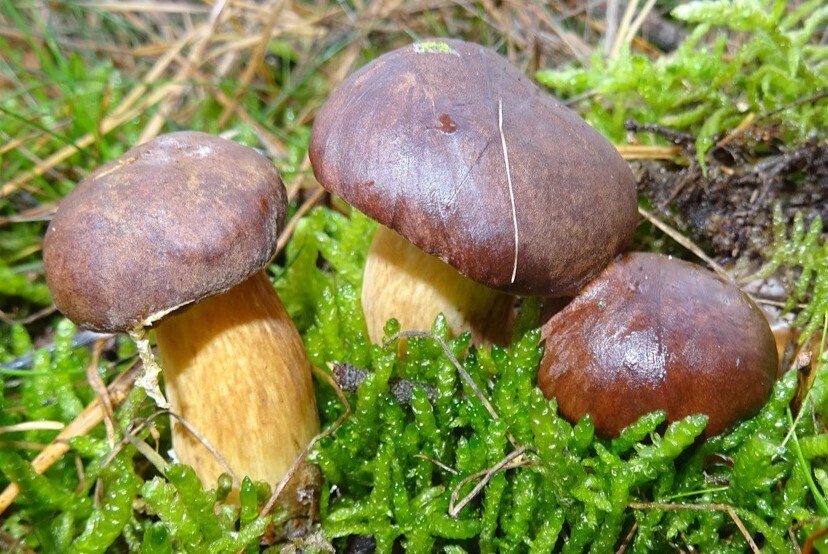
Bay Bolete
Imleria badia
Fungusstrong against amphibians, reptiles
Common
Mycelium
While active with another fungus in play, it regains 5 HP at the start of your turn (8 with two others).
41

27
Bay Bolete
Imleria badia
Fungusstrong against amphibians, reptiles
Common
While active with another fungus in play, it regains 5 HP at the start of your turn (8 with two others).
Imleria badia
Photo: © Andre Fischer (original photo) · CC BY 4.0 (licence text) · cropped
Strong against: it deals 20% more damage to them. Weak against: these types deal 20% more damage to it.
Imleria badia, commonly known as the bay bolete, is a species of pored mushroom. First described scientifically by Elias Fries in 1818, the bay bolete was reclassified as Xerocomus badius in 1931, and it is still listed thus in several sources. Modern molecular phylogenetic studies show Xerocomus to be polyphyletic (not descended from the same common ancestor), and the bay bolete is not particularly closely related to species in that genus.
Both the common and scientific names refer to the bay- or chestnut-coloured cap, which is almost spherical in young specimens before broadening and flattening out to a diameter up to 15 cm (6 in). On the cap underside are small yellowish pores that turn dull blue-grey when bruised. The smooth, cylindrical stipe, measuring 4–9 cm (1+1⁄2–3+1⁄2 in) long by 1–2 cm (1⁄2–3⁄4 in) thick, is coloured like the cap, but paler. The species is found in Eurasia and North America, growing in coniferous or mixed woods on the ground or on decaying tree stumps, sometimes in prolific numbers. Some varieties have also been described from eastern North America, differing from the main type in both macroscopic and microscopic morphology.
Abridged excerpt from the Wikipedia article Imleria badia, by its authors, under the CC BY-SA 4.0 licence.
Least Concern on the IUCN Red List: that’s what makes this card Common.
Every Common card has 100 points, shared between HP, ATK and DEF:
How they’re shared out:

 DEF 27