 …
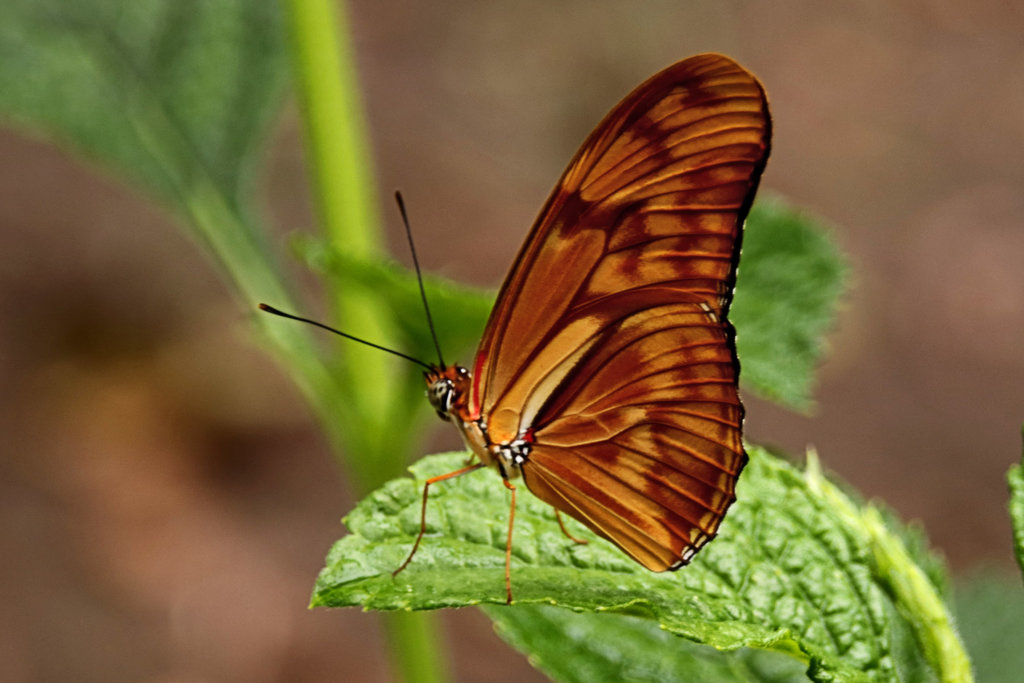
Julia Heliconian
Dryas iulia
Insectstrong against fungi, fish
Common
Swarm
While active with another insect in play, each of its attacks also hits the opposing bench for 10, without knocking them out (20 with two others).
43

35
Julia Heliconian
Dryas iulia
Insectstrong against fungi, fish
Common
While active with another insect in play, each of its attacks also hits the opposing bench for 10, without knocking them out (20 with two others).
Dryas iulia
Photo: Dennis White (original photo) · CC0 (licence text) · cropped
Strong against: it deals 20% more damage to them. Weak against: these types deal 20% more damage to it.
Dryas iulia (often incorrectly spelled julia), commonly called the Julia butterfly, Julia heliconian, the flame, or flambeau, is a species of brush-footed (or nymphalid) butterfly. The sole representative of its genus Dryas, it is native from Brazil to southern Texas and Florida, and in summer can sometimes be found as far north as eastern Nebraska. Over 15 subspecies have been described.
Its wingspan ranges from 82 to 92 mm, and it is colored orange (brighter in male specimens) with black markings; this species is somewhat unpalatable to birds and belongs to the "orange" Müllerian mimicry complex.
This butterfly is a fast flier and frequents clearings, paths, and margins of forests and woodlands. It feeds on the nectar of flowers, such as lantanas (Lantana) and shepherd's-needle (Scandix pecten-veneris), and drinks the tears of caiman, the eye of which the butterfly irritates to produce tears. Its caterpillar feeds on leaves of passion vines, including Passiflora affinis and yellow passionflower (P. lutea) in Texas.
Its mating behavior is complex and involves a prolonged courtship whose outcome appears to be controlled by the female. This raises questions pertaining to the occurrence of the evolution of sexual conflict.
The species is popular in butterfly houses because it is long-lived and active throughout the day. However, the caterpillars are spiky and may cause a skin rash.
Excerpt from the Wikipedia article Dryas iulia, by its authors, under the CC BY-SA 4.0 licence.
No global status on the IUCN Red List: that’s what makes this card Common.
Every Common card has 100 points, shared between HP, ATK and DEF:
How they’re shared out:

 DEF 35