 …
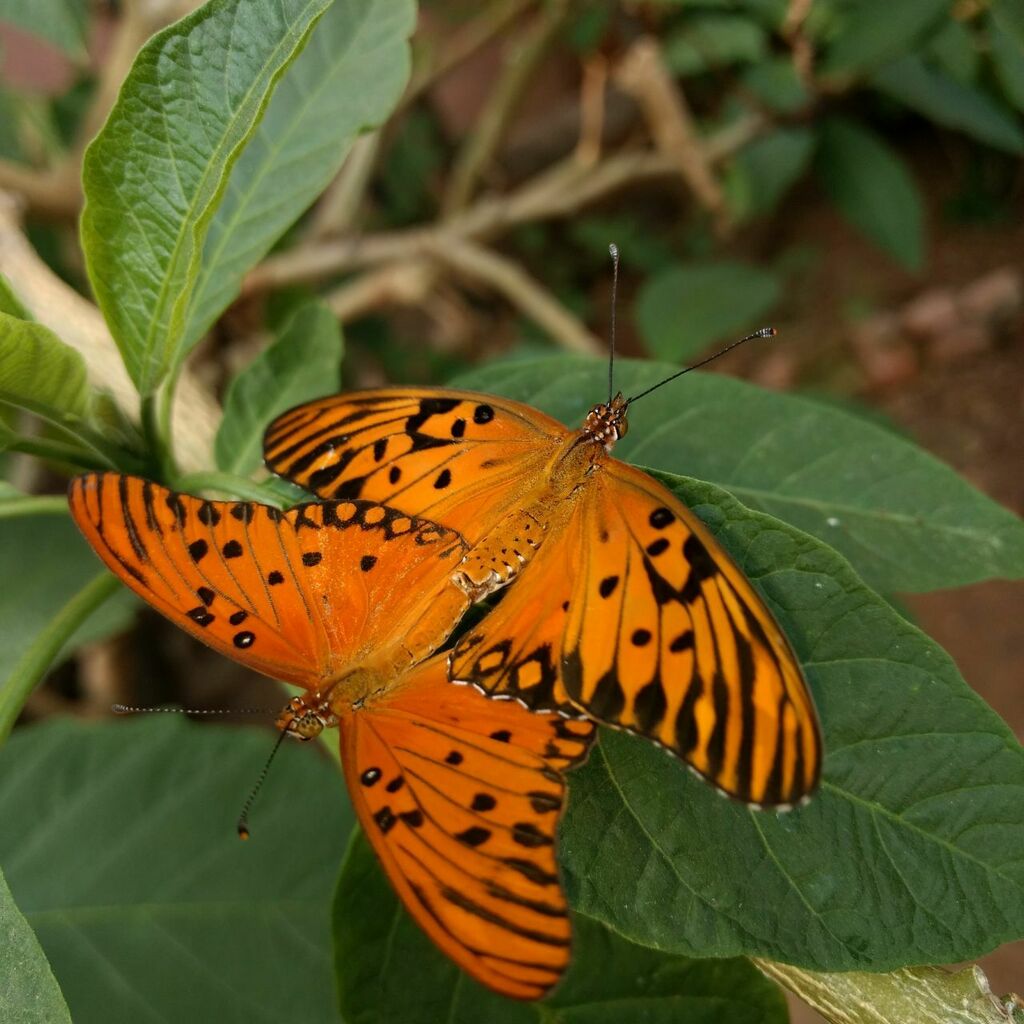
Gulf Fritillary
Dione vanillae
Insectstrong against fungi, fish
Common
Swarm
While active with another insect in play, each of its attacks also hits the opposing bench for 10, without knocking them out (20 with two others).
44

35
Gulf Fritillary
Dione vanillae
Insectstrong against fungi, fish
Common
While active with another insect in play, each of its attacks also hits the opposing bench for 10, without knocking them out (20 with two others).
Dione vanillae
Photo: © ISAAC FELIPE 8425 (original photo) · CC BY-SA 4.0 (licence text) · cropped
Strong against: it deals 20% more damage to them. Weak against: these types deal 20% more damage to it.
The Gulf fritillary or passion butterfly (Dione vanillae or Agraulis vanillae in other taxonomies) is a bright orange butterfly in the subfamily Heliconiinae of the family Nymphalidae. That subfamily was formerly set apart as a separate family, the Heliconiidae. The Heliconiinae are "longwing butterflies", which have long, narrow wings compared to other butterflies.
Dione vanillae is most commonly found in the southern areas of the United States, specifically in many regions of Florida and Texas.
Gulf fritillaries have a chemical defense mechanism in which they release odorous chemicals in response to predator sightings. As a result, common predators learn to avoid this species. Pheromones play a critical role in male-female courtship behaviors, with male gulf fritillaries emitting sex pheromones that contribute to mate choice in females.
The scientific name Papilio vanillae was given to the gulf fritillary by Carl Linnaeus in 1758, based on a 1705 painting by Maria Sibylla Merian (The Metamorphosis of the Insects of Surinam, Plate XXV), which shows the adult and caterpillar of the gulf fritillary on a vanilla orchid, Vanilla planifolia. However, it is now known that the gulf fritillary caterpillar does not use the vanilla plant. The species was moved to the genus Agraulis in 1835 by Boisduval & Le Conte. A phylogenetic analysis reported in 2019 placed Agraulis as a sub-genus of Dione.
Excerpt from the Wikipedia article Gulf fritillary, by its authors, under the CC BY-SA 4.0 licence.
Least Concern on the IUCN Red List: that’s what makes this card Common.
Every Common card has 100 points, shared between HP, ATK and DEF:
How they’re shared out:

 DEF 35