 …
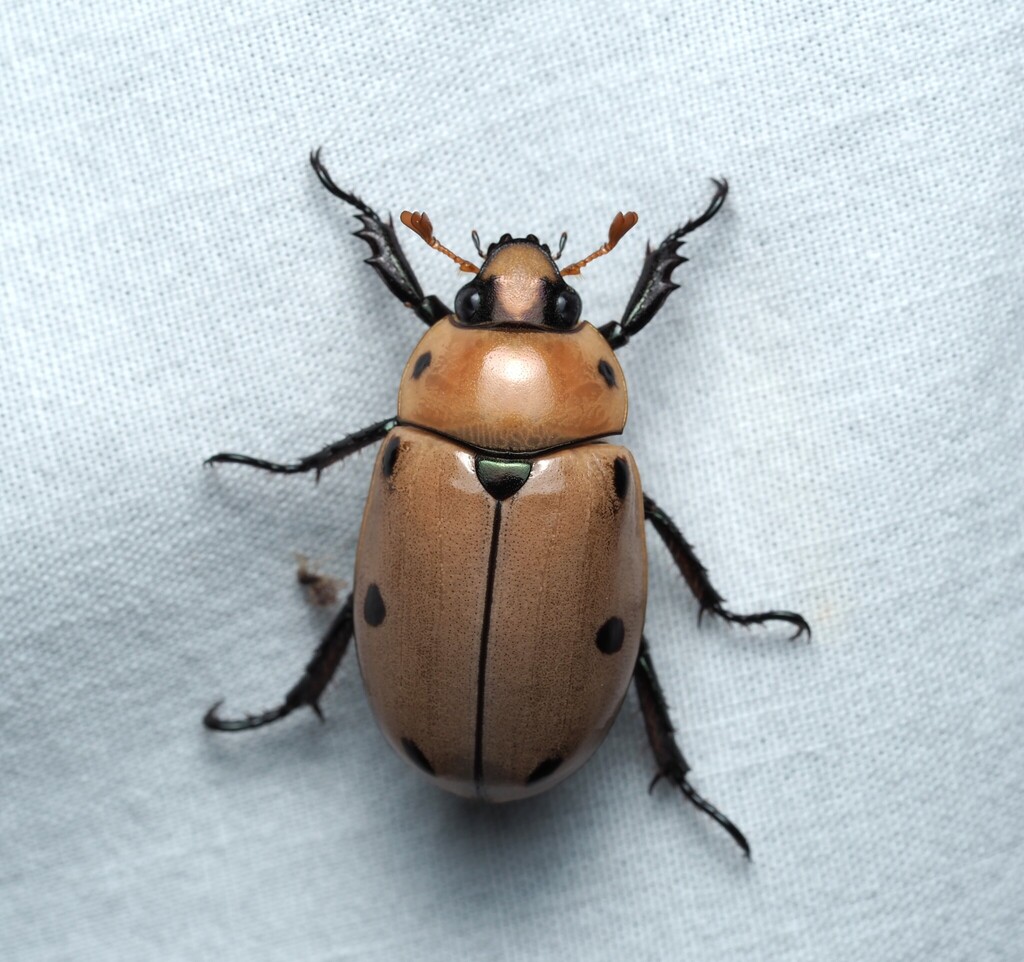
Grapevine Beetle
Pelidnota punctata
Insectstrong against fungi, fish
Common
Swarm
While active with another insect in play, each of its attacks also hits the opposing bench for 10, without knocking them out (20 with two others).
41

37
Grapevine Beetle
Pelidnota punctata
Insectstrong against fungi, fish
Common
While active with another insect in play, each of its attacks also hits the opposing bench for 10, without knocking them out (20 with two others).
Pelidnota punctata
Photo: iNaturalist (original photo) · CC0 (licence text) · cropped
Strong against: it deals 20% more damage to them. Weak against: these types deal 20% more damage to it.
Pelidnota punctata, the grapevine beetle, spotted June beetle or spotted pelidnota, is a species of beetle in the family Scarabaeidae (Scarab beetles), subfamily Rutelinae. Grapevine beetles are common in the north and central United States and eastern Canada, but do relatively little damage to their host plants. The beetles fly at a fast speed, usually in a curving flight.
The adult beetle is approximately 2.5 centimetres (1 inch) long, but can reach 3 cm (1.2 in) occasionally. Its pattern is off-yellow or auburn red, with four black spots running down each side. Fine black lines divide the edges of its elytra. There are regional variants of Pelidnota punctata: a common southern form lacks the darker legs, while the northern form has darker legs. Adults in the northern parts of its range will have darker and more spots, while those in the southern regions may not have them at all. The grapevine beetle is a variable species, whose taxonomy was confused by a single authority (Thomas Casey) who split the species into 11 different taxa in 1915, only to have these names relegated to synonymy by subsequent workers.
Excerpt from the Wikipedia article Pelidnota punctata, by its authors, under the CC BY-SA 4.0 licence.
No global status on the IUCN Red List: that’s what makes this card Common.
Every Common card has 100 points, shared between HP, ATK and DEF:
How they’re shared out:

 DEF 37