 …
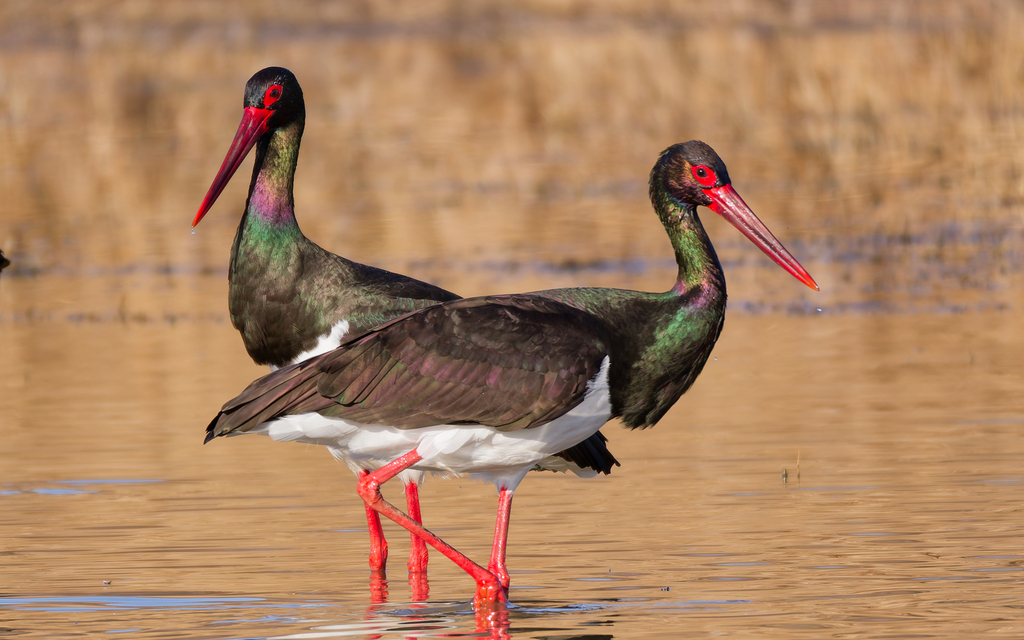
Black Stork
Ciconia nigra
Birdstrong against fish, reptiles
Common
Swoop
While active with another bird in play, it hits 6 harder on its first attack after entering play (12 with two others).
28

30
Black Stork
Ciconia nigra
Birdstrong against fish, reptiles
Common
While active with another bird in play, it hits 6 harder on its first attack after entering play (12 with two others).
Ciconia nigra
Photo: © Zinogre (original photo) · CC BY-SA 4.0 (licence text) · cropped
Strong against: it deals 20% more damage to them. Weak against: these types deal 20% more damage to it.
The black stork (Ciconia nigra) is a large bird in the stork family Ciconiidae. It was first described by Carl Linnaeus in the 10th edition of his Systema Naturae. Measuring on average 95 to 100 cm (37 to 39 in) from beak tip to end of tail with a 145-to-155 cm (57-to-61 in) wingspan, the adult black stork has mainly black plumage, with white underparts, long red legs and a long pointed red beak. A widespread but uncommon species, it breeds in scattered locations across Europe (predominantly in Portugal and Spain, and central and eastern parts), and east across the Palearctic to the Pacific Ocean. It is a long-distance migrant, with European populations wintering in tropical Sub-Saharan Africa, and Asian populations in the Indian subcontinent. When migrating between Europe and Africa, it avoids crossing broad expanses of the Mediterranean Sea and detours via the Levant in the east, the Strait of Sicily in the center, or the Strait of Gibraltar in the west. An isolated non-migratory population lives in Southern Africa.
Abridged excerpt from the Wikipedia article Black stork, by its authors, under the CC BY-SA 4.0 licence.
Least Concern on the IUCN Red List: that’s what makes this card Common.
Every Common card has 100 points, shared between HP, ATK and DEF:
How they’re shared out:

 DEF 30