
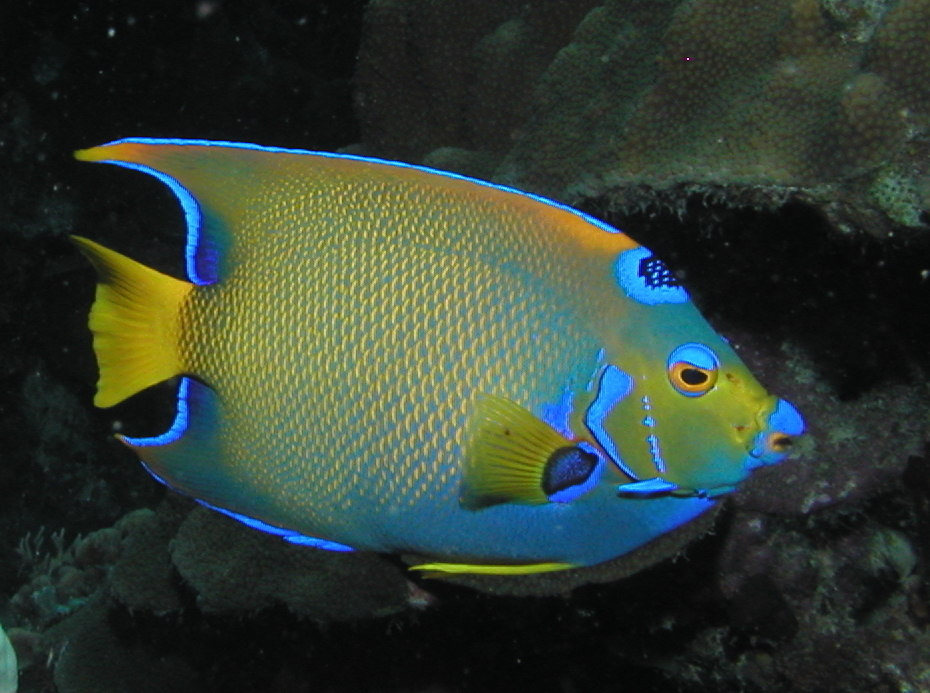
Queen Angelfish
Holacanthus ciliaris
Fishstrong against mammals, arachnids
Common
While active with another fish in play, a fish on your bench absorbs up to 9 of the damage this card takes, without being knocked out (18 with two others).

Queen Angelfish
Holacanthus ciliaris
Fishstrong against mammals, arachnids
Common
While active with another fish in play, a fish on your bench absorbs up to 9 of the damage this card takes, without being knocked out (18 with two others).
Holacanthus ciliaris
Photo: © desertnaturalist (original photo) · CC BY 4.0 (licence text) · cropped
Strong against: it deals 20% more damage to them. Weak against: these types deal 20% more damage to it.
The queen angelfish (Holacanthus ciliaris), also known as the blue angelfish, golden angelfish, or yellow angelfish, is a species of marine angelfish found in the western Atlantic Ocean. It is a benthic (ocean floor) warm-water species that lives in coral reefs. It is recognized by its blue and yellow coloration and a distinctive spot or "crown" on its forehead. This crown distinguishes it from the closely related and similar-looking Bermuda blue angelfish (Holacanthus bermudensis), with which it overlaps in range and can interbreed.
Adult queen angelfish are selective feeders and primarily eat sponges. Their social structure consists of harems which include one male and up to four females. They live within a territory where the females forage separately and are tended to by the male. Breeding in the species occurs near a full moon. The transparent eggs float in the water until they hatch. Juveniles of the species have different coloration than adults and act as cleaner fish.
The queen angelfish is popular in the aquarium trade and has been a particularly common exported species from Brazil. In 2010, the queen angelfish was assessed as least concern by the International Union for Conservation of Nature as the wild population appeared to be stable.
Excerpt from the Wikipedia article Queen angelfish, by its authors, under the CC BY-SA 4.0 licence.
Least Concern on the IUCN Red List: that’s what makes this card Common.
Every Common card has 100 points, shared between HP, ATK and DEF:
How they’re shared out:

