 …
Ringed China-Mark
Parapoynx stratiotata
Insectstrong against fungi, fish
Common
Swarm
While active with another insect in play, each of its attacks also hits the opposing bench for 10, without knocking them out (20 with two others).
40

39
Ringed China-Mark
Parapoynx stratiotata
Insectstrong against fungi, fish
Common
While active with another insect in play, each of its attacks also hits the opposing bench for 10, without knocking them out (20 with two others).
Parapoynx stratiotata
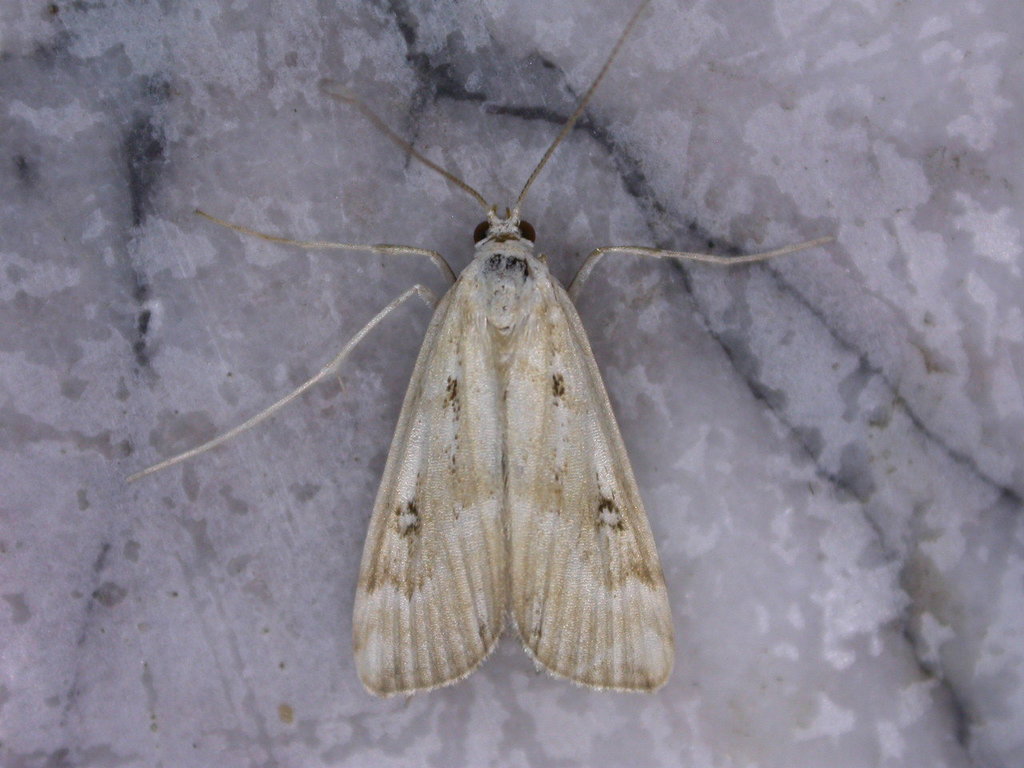
Photo: © Donald Hobern (original photo) · CC BY 4.0 (licence text) · cropped
Strong against: it deals 20% more damage to them. Weak against: these types deal 20% more damage to it.
Parapoynx stratiotata, the ringed china-mark, is a moth of the family Crambidae. The species was first described by Carl Linnaeus in his 1758 10th edition of Systema Naturae. It is found in Europe where the distribution area extends in the north to the British Isles including Ireland and in the south to Sardinia, Sicily and Greece. The species is also found across the Palearctic in North Africa, Lebanon, Turkey, Azerbaijan, Kyrgyzstan, Uzbekistan and China..
The wingspan is 20–24 mm for the males and 28–30 mm for the females. The forewings are pale ochreous brownish, sometimes partly suffused with white in disc; lines white, first indistinct, posteriorly partly edged with dark brown, second sinuate, anteriorly suffusedly edged with dark brown; a white discal spot, edged with dark fuscous; a white subterminal streak. Hindwings are white; a thick dark fuscous postmedian line; a fine dark subterminal line; termen yellow-tinged. The larva with eight series of groups of fleshy filaments, serving as branchiae; whitish-ochreous or pale greenish, slightly purplish freckled; dorsal line rather dark grey; head pale brown.
The moth flies from May to September depending on the location.
The larvae feed on Nymphaea alba, Potamogeton, Callitriche, Ceratophyllum demersum, Elodea canadensis, Nuphar lutea and Stratiotes.
Excerpt from the Wikipedia article Parapoynx stratiotata, by its authors, under the CC BY-SA 4.0 licence.
No global status on the IUCN Red List: that’s what makes this card Common.
Every Common card has 100 points, shared between HP, ATK and DEF:
How they’re shared out:

 DEF 39