 …
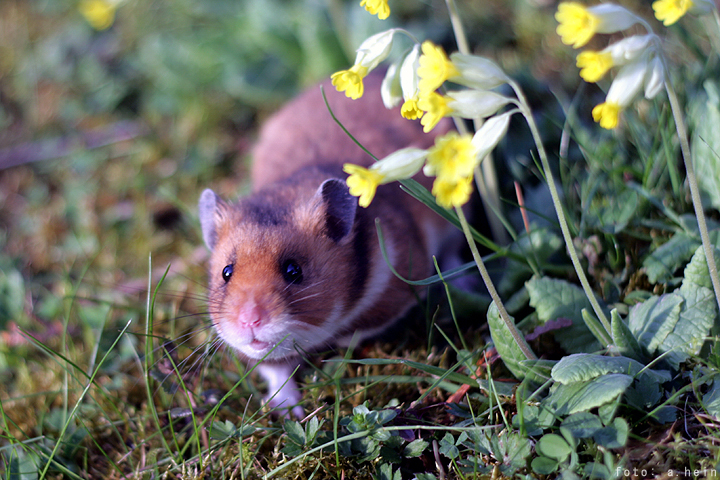
Golden Hamster
Mesocricetus auratus
Mammalstrong against birds, fungi
Epic
Pack
While active with another mammal in play, it hits 7 harder (14 with two others).
44

54
Golden Hamster
Mesocricetus auratus
Mammalstrong against birds, fungi
Epic
While active with another mammal in play, it hits 7 harder (14 with two others).
Mesocricetus auratus
Photo: © Sqrt (original photo) · CC BY 4.0 (licence text) · cropped
Strong against: it deals 20% more damage to them. Weak against: these types deal 20% more damage to it.
The golden hamster or Syrian hamster (Mesocricetus auratus) is a rodent belonging to the hamster subfamily, Cricetinae. Their natural geographical range is in an arid region of northern Syria and southern Turkey. Their numbers have been declining in the wild due to a loss of habitat from agriculture and deliberate elimination by humans. Thus, wild golden hamsters are now considered endangered by the International Union for Conservation of Nature. However, captive breeding programs are well established, and captive-bred golden hamsters are often kept as small house pets. They are also used as scientific research animals.
Syrian hamsters kept as pets are sensitive to their housing conditions, and many welfare concerns have been identified in association with inadequate care. Major concerns include undersized cages, the presence of predatory species (dogs and cats) in the hamster's environment, insufficient substrate depth, excessive handling, noise, and wet tail (proliferative ileitis), the risk of which is increased by poor hygiene and cage cleanliness and high levels of stress.
Syrian hamsters are larger than many of the dwarf hamsters kept as pocket pets (up to five times larger), though the wild European hamster exceeds Syrian hamsters in size.
Excerpt from the Wikipedia article Golden hamster, by its authors, under the CC BY-SA 4.0 licence.
Endangered on the IUCN Red List: that’s what makes this card Epic.
Every Epic card has 145 points, shared between HP, ATK and DEF:
How they’re shared out:

 DEF 54