 …
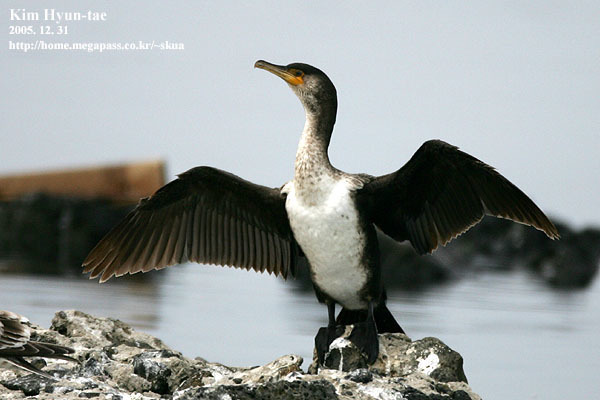
Japanese Cormorant
Phalacrocorax capillatus
Birdstrong against fish, reptiles
Common
Swoop
While active with another bird in play, it hits 6 harder on its first attack after entering play (12 with two others).
29

34
Japanese Cormorant
Phalacrocorax capillatus
Birdstrong against fish, reptiles
Common
While active with another bird in play, it hits 6 harder on its first attack after entering play (12 with two others).
Phalacrocorax capillatus
Photo: © Kim, Hyun-tae (original photo) · CC BY 4.0 (licence text) · cropped
Strong against: it deals 20% more damage to them. Weak against: these types deal 20% more damage to it.
The Japanese cormorant (Phalacrocorax capillatus), also known as Temminck's cormorant, is a species of cormorant native to coastal areas of the east Palearctic.
The species has a black body with a white throat and cheeks and a partially yellow bill. Juveniles are plainer and browner in appearance. It is one of the larger cormorants and is comparable in size to the great cormorant. Adults measure 81 to 92 cm (32 to 36 in) in length with a wingspan of around 152 cm (60 in), and may weigh 2.3 to 3.55 kg (5.1 to 7.8 lb).
The Japanese cormorant is found along the coasts of East Asia, including China, Japan, North Korea, the Russian Far East, South Korea and Taiwan. It is migratory in parts of its range and feeds mainly on fish, which it catches by diving underwater.
It is one of the species of cormorant traditionally trained by fishermen in Japan for cormorant fishing, a practice known as ukai (鵜飼). In Japanese, the species is known as umiu (ウミウ; "sea cormorant"). The fishing masters of the Nagara River traditionally use this species to catch ayu.
Excerpt from the Wikipedia article Japanese cormorant, by its authors, under the CC BY-SA 4.0 licence.
Least Concern on the IUCN Red List: that’s what makes this card Common.
Every Common card has 100 points, shared between HP, ATK and DEF:
How they’re shared out:

 DEF 34